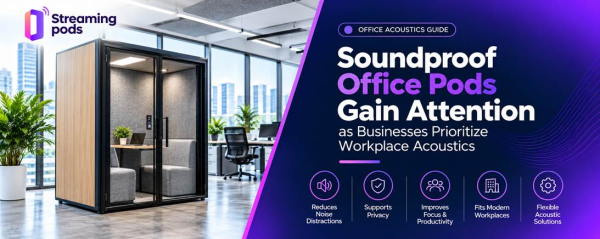
As businesses rethink open-plan layouts and hybrid work environments, modular acoustic workspaces offer practical options for reducing distractions, supporting private conversations and improving office flexibility.
HAYWARD, Calif., Workplace acoustics are becoming an increasingly important consideration as businesses evaluate how their offices support concentration, communication and privacy. With open-plan environments accommodating phone calls, virtual meetings and collaborative activities in shared spaces, organizations are exploring Office Pods as an adaptable way to introduce quieter, enclosed work areas. StreamingPods, a provider of modular acoustic workplace solutions, offers individual booths and meeting enclosures designed to address these everyday challenges without requiring businesses to redesign their entire office layouts.
The growing relevance of Soundproof Office Pods reflects a broader emphasis on acoustic comfort and functional workplace design. As companies balance collaborative environments with the need for individual concentration, Modern Office Pods provide dedicated spaces for calls, video conferences, focused assignments and small-group discussions. These enclosed solutions can help organizations create more versatile workplaces while preserving the accessibility and collaborative advantages of existing office layouts.
Workplace Noise Creates Challenges for Modern Businesses
Open-plan offices encourage interaction and make efficient use of available space, but they can also expose employees to frequent interruptions. Conversations between colleagues, ringing phones, virtual meetings and general office activity contribute to a background noise environment that may interfere with concentration.
Employees performing detailed assignments often need uninterrupted periods to review information, prepare reports or complete complex projects. At the same time, professionals participating in confidential conversations require greater speech privacy than many shared work areas can provide.
These competing needs have encouraged workplace planners to reconsider how quiet spaces are distributed throughout commercial offices.
Traditional solutions often involve constructing additional meeting rooms, adding partitions or reserving existing conference facilities for individual calls. Although these approaches can be appropriate in certain settings, they may require significant planning, dedicated floor space or permanent alterations.
Modular acoustic enclosures offer another option by introducing defined workspaces within an existing environment.
How Office Pods Support Acoustic Privacy and Flexible Workspaces
Enclosed acoustic workspaces are designed to reduce the transfer of sound between occupants and surrounding office areas. Their construction generally combines sound-absorbing materials, insulated panels, enclosed doors and carefully designed structural connections.
Unlike open workstations, these environments provide a physical boundary between an individual and nearby activity. This separation can make telephone conversations easier to manage and reduce distractions during concentration-intensive assignments.
However, acoustic privacy does not mean complete sound isolation. Actual performance depends on enclosure construction, installation, surrounding noise levels and the frequency and intensity of nearby sounds.
Organizations evaluating office pods should therefore distinguish between reducing audible distractions and guaranteeing that conversations cannot be heard outside an enclosure.
For businesses handling sensitive information, appropriate acoustic design can complement established privacy procedures, but it should not replace organizational security policies or safeguards for confidential communications.
Supporting Hybrid Work and Video Communication
Hybrid work arrangements have changed how employees use physical workplaces. On-site staff may participate in virtual meetings with remote colleagues throughout the day, often requiring spaces that support clear communication without disturbing nearby teams.
A conventional conference room may accommodate these interactions, but reserving a large meeting area for one participant can create scheduling challenges.
Compact office phone booths offer a more targeted alternative for individual video calls, interviews, client discussions and short virtual meetings.
Larger acoustic meeting enclosures can accommodate face-to-face conversations, collaborative planning and small-team discussions that require greater separation from general office activity.
The availability of differently sized spaces allows workplace managers to match enclosure capacity to actual employee needs.
Rather than treating every meeting or focused assignment as requiring a conventional room, organizations can consider a mixture of shared desks, collaborative zones, enclosed booths and dedicated meeting facilities.
This approach supports workplace flexibility while allowing existing office infrastructure to remain largely intact.
Acoustic Design, Ventilation and Everyday Functionality
Effective acoustic workplace design involves more than installing sound-insulating materials. Enclosed environments must also provide adequate airflow, comfortable lighting, practical power access and enough interior space for their intended activities.
StreamingPods offers modular configurations ranging from single-person work booths to multi-person meeting spaces. Its published product information describes acoustic insulation, integrated ventilation fans, LED lighting, electrical outlets and movable designs intended for professional environments.
Ventilation is particularly important because enclosed workspaces require air circulation to remain comfortable during calls and meetings. Integrated lighting also supports visibility when employees review documents or work on computers.
Electrical connectivity allows users to operate laptops and charge devices without relying on separate workstations.
Acoustic construction presents additional considerations. The company’s listed configurations include layered sound-control materials, with some models incorporating laminated glass, acoustic panels and sound-absorbing interior surfaces.
These components are intended to limit noise transfer while maintaining a functional environment for daily workplace activities.
The effectiveness of any enclosure should be evaluated using relevant specifications for the complete product rather than assumptions based solely on individual materials.
Modular Installation Offers Workplace Adaptability
Commercial workplaces regularly change in response to staffing requirements, organizational growth and evolving operational priorities.
Permanent construction can be useful for long-term space planning, but it may offer less flexibility when departments relocate or office layouts change.
Modular acoustic enclosures provide an alternative because they can be incorporated into existing floor plans without necessarily requiring new permanent interior walls.
Some configurations can also be repositioned when workplace needs change, subject to product dimensions, access routes and installation requirements.
For facility managers, this flexibility creates opportunities to adjust the distribution of quiet spaces as teams expand, departments reorganize or shared work areas are repurposed.
Architects and interior designers can similarly consider modular enclosures alongside established workplace planning features such as collaborative seating, meeting rooms and circulation areas.
Nevertheless, installation considerations remain important. Businesses should evaluate available floor space, electrical access, ventilation requirements, accessibility, fire safety and applicable building regulations before selecting an enclosure.
Modular construction should not be interpreted as an exemption from local compliance obligations.
Workplace Privacy as Part of Employee Experience
Acoustic comfort contributes to how employees experience their surroundings. In offices where conversations frequently overlap, workers may struggle to find appropriate locations for concentrated assignments or discussions involving sensitive information.
Dedicated enclosed workspaces offer employees additional choice over where they perform particular tasks.
For example, human resources professionals may require private locations for interviews or employee discussions. Sales representatives may need quieter settings for customer calls, while project teams may benefit from enclosed areas for short planning sessions.
Workplace designers can address these needs by considering the frequency, duration and confidentiality of different activities.
The most appropriate solution will vary according to staffing levels, floor plans, communication patterns and the availability of existing private rooms.
Acoustic enclosures should therefore be viewed as one element of a broader workplace strategy rather than a universal solution to office noise.
Evaluating Acoustic Solutions for Long-Term Workplace Needs
When considering enclosed workspace options, organizations should examine acoustic performance, interior dimensions, ventilation, lighting, accessibility, durability and installation requirements.
Product selection should also account for how frequently a space will be occupied, whether users will remain seated or standing, and how many participants need to communicate comfortably.
Facility managers may benefit from evaluating available floor space and identifying common sources of workplace distraction before determining the number or size of enclosures required.
Businesses can also consider how modular workspaces interact with existing meeting-room availability and employee scheduling practices.
As organizations continue balancing collaboration with focused individual work, acoustic privacy is likely to remain a relevant consideration in office planning.
Businesses examining modern office pods can assess how enclosed acoustic spaces may complement existing workplaces, provide additional privacy options and support changing operational requirements.
About StreamingPods
The company provides modular acoustic workspaces for commercial offices and professional environments. Its product range includes individual privacy booths, multi-person meeting enclosures and larger modular meeting spaces designed to support workplace communication, concentration and flexible office planning. The company is based in Hayward, California.
Leave a Reply
You must be logged in to post a comment.