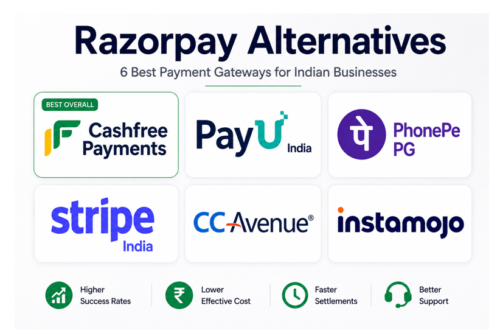
Leaning on a single payment gateway creates operational risk that most growing businesses can no longer afford, which is why more of them now run more than one provider to cut their dependency on any single platform.
Razorpay is another player in Indian payments, and on the product side it is good enough for most teams getting started. The reasons businesses start shopping for alternatives usually show up later, at scale, and they are rarely about the product. First, it charges a premium, so your effective cost tends to run higher than newer players. Second, support quality doesn’t keep up: across independent review platforms, the recurring themes are fund holds and account freezes with no clear explanation and generic ticket responses, and dedicated support is reserved for enterprise-level customers, so smaller and growing merchants are left in general queues exactly when a frozen settlement is hurting them most. For a business where cash flow is tight, that is a real risk worth designing around.
So a good Razorpay alternative needs to offer more than payment collection. It should bring higher success rates, lower effective cost, faster settlements, and dependable support. Beyond that, it is worth weighing onboarding consistency, API maturity, webhook reliability, settlement flexibility, payout infrastructure, compliance readiness, and support for both domestic and cross-border payments. Here are the six strongest options for 2026.
Top 6 Razorpay Alternatives in India
When you compare alternatives, look past the headline MDR or TDR to the total cost of ownership. The list below weighs pricing, settlement time, TCO, and the features that genuinely strengthen your payment infrastructure.
| Payment Gateway | Best For | Transaction Cost* | Setup Cost | Settlement Timeline |
| Cashfree Payments | Ecommerce, startups, SMBs, and enterprises | Flat 1.6% MDR for all businesses | ₹0 | T+1 (instant available for eligible merchants) |
| PayU India | Enterprises | 1.75% onwards | ₹0 | T+1 to T+2 |
| PhonePe PG | Mobile-first consumer brands | Custom | ₹0 | T+1 to T+2 |
| Stripe India | Global SaaS | 2%+ | ₹0 | T+2 onwards |
| CCAvenue | Traditional enterprises | 2.00% onwards | ₹0 | T+1 to T+3 |
| Instamojo | Small businesses | 2%+ | ₹0 | T+1 to T+3 |
*Pricing is indicative and varies by business category, volume, and payment mode.
Cashfree Payments
Cashfree empowers tech-first businesses with a trusted, feature-rich payment gateway and dedicated support, all for a highly competitive flat 1.6% MDR. It is the perfect choice for companies ready to accelerate their payment acceptance and effortlessly optimize their checkout experience. It brings:
- Faster onboarding
- Fewer payment failures
- A smoother checkout experience
Most businesses can go live the same day and start collecting without long setup cycles. From there, the platform is built around conversion outcomes:
- AI-powered checkout optimisation, including One Click Checkout
- Higher payment success rates with intelligent routing
- One of the best affordability suites in the market for EMI and BNPL, plus an offer engine for custom discounts
- RiskShield, a built-in fraud-monitoring tool that cuts fraud by up to 40%
- Faster refunds and tooling that reduces COD and RTO losses
- A dedicated account manager, with email and chat support, available even to smaller merchants, who actively helps protect leakages and optimize conversion
Businesses expanding abroad can collect across 180+ currencies with local settlement, without bolting on a separate payments stack. Backing all of it is over a decade of payments experience and infrastructure proven at national scale, including IRCTC’s ticketing, and an RBI Payment Aggregator Cross-Border license earned as the first non-banking company to receive it.
Reason to switch: Cashfree pairs the developer experience modern teams expect with the things that actually protect revenue: quick go-live, conversion optimisation, instant settlements, real human support, and cross-border collections.
Pros:
- Same-day go-live for many businesses
- Strong payment success-rate performance
- AI-powered checkout optimisation and a full growth stack
- Dedicated account-manager support, not just a ticket queue
Cons:
- Custom pricing may need a conversation with sales for larger deployments
PayU India
PayU remains one of India’s most established payment processors, with real scale, deep banking relationships, and an enterprise focus that makes it reliable for businesses pushing large transaction volumes. It is a natural fit for enterprises, regulated sectors, and large marketplaces.
Reason to switch: PayU’s depth across large enterprises and institutional clients suits businesses that prioritise operational maturity and established risk controls.
Pros:
- Proven enterprise stability
- Extensive risk-management capabilities
- Strong banking network
Cons:
- Built for the enterprise end, so its growth tooling has not kept pace and support leans toward large accounts
- Less payout-focused than Cashfree
- Integration can take more implementation effort
PhonePe Payment Gateway
PhonePe is a relatively new entrant on the gateway side, and most of its early traction comes from the strength of the PhonePe consumer brand rather than the gateway itself. That familiarity helps at checkout for mobile-first audiences, since most Indian shoppers already use the app. The merchant-facing growth stack is still being built out, so teams that need conversion and revenue-recovery tooling ready to go may find it limited for now.
Reason to switch: PhonePe’s large consumer ecosystem makes it relevant for businesses that want a payment experience that feels native to India’s mobile-first shoppers.
Pros:
- Strong UPI transaction performance
- Familiar customer experience
- Backed by a large payment network
Cons:
- Smaller, still-maturing product ecosystem compared with multi-product providers
- Limited cross-border focus
Stripe India
Stripe remains a favourite for global, SaaS-oriented companies operating in India. Its developer tooling, subscription billing, and international acceptance sit on top of a robust payments infrastructure.
Reason to switch: Stripe is strongest for globally distributed businesses that want a single, developer-centric stack rather than separate tools per region.
Pros:
- Excellent developer documentation
- Strong recurring-billing capabilities
- Global payment coverage
Cons:
- Domestic payment optimisation trails local gateways
- Settlement flexibility is more limited
CCAvenue
CCAvenue is one of the oldest gateways in India and is still used widely where businesses need niche payment methods or legacy banking integrations.
Reason to switch: It stays relevant for businesses that need broad coverage across older banking systems and institutional environments.
Pros:
- Wide payment-method coverage
- Long-standing market presence
- Trusted by public-sector organisations
Cons:
- User experience feels dated
- Developer experience is less modern
Instamojo
Instamojo is a clean fit for small-scale businesses and solo ventures, including micro-merchants, creators, freelancers, and social sellers. It prioritises simplicity over deep infrastructure.
Reason to switch: Instamojo stays popular with creators and small merchants who want to start collecting quickly without heavy implementation.
Pros:
- Quick onboarding
- Easy payment links
- Minimal technical requirements
Cons:
- Limited enterprise capabilities
- Not ideal for complex payout workflows
Payment Gateway Migration Checklist | Switching from Razorpay
- Validate APIs and sandbox flows. Map your existing payment APIs, webhooks, refund flows, and reconciliation events against the new gateway, and test every lifecycle event in the sandbox before going to production.
- Re-onboard vendors and compliance structures. If you handle payouts, confirm vendor KYC, beneficiary management, and settlement workflows stay compliant. Missing compliance dependencies can interrupt disbursals even while collection keeps working.
- Use controlled traffic routing. Route about 10% of traffic through the new gateway while keeping 90% on the old one, and avoid a hard cutover. Watch authorisation rates, UPI success rates, webhook delivery, refund performance, and settlement timelines, then increase allocation as benchmarks hold.
Conclusion | Which Razorpay Alternative Is Best?
The right alternative depends on your model. Global businesses may lean toward Stripe, and mobile-first consumer brands may lean toward PhonePe.
But if you want one platform that ticks every box, go with Cashfree. It matches the developer experience modern teams expect and adds the capabilities that directly affect operating efficiency: instant settlements, market-leading payout infrastructure, dedicated support that actively protects revenue, and a growing cross-border framework backed by RBI PA-CB authorisation.
Leave a Reply
You must be logged in to post a comment.