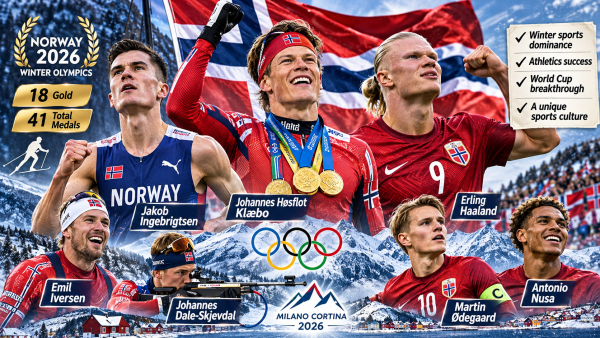
Norway has a little over five and a half million people. That is fewer than many single cities around the world. And yet, if you followed sport at all in 2026, you probably heard Norwegian names more often than you heard your own country’s. A record haul at the Winter Olympics, a World Cup run nobody saw coming, and a running star who came back from surgery and won again within months. It has been quite a year.
So what is going on up there? Let’s look at the people behind the headlines, and at the system that keeps producing them.
Why Norway Punches Above Its Weight
Ask a Norwegian about it and you will often get a shrug. Sport is just part of normal life there. Kids go skiing after school because the trails are right outside the door. Families spend weekends hiking, and the word friluftsliv, roughly “open air living”, describes something most people actually do rather than something they post about.
But it is not all luck and snow. The country has built a sports culture that keeps children playing for longer. The Norwegian Olympic and Paralympic Committee and Confederation of Sports has rules for children’s sport that push fun and participation ahead of early rankings. Young kids are not sorted into “talented” and “not talented” at age eight. They just play. Plenty of them stay in sport into their teens, and that wide base is where the champions eventually come from.
Clubs are local and run largely by volunteers. Parents coach, drive, and sell waffles at the kiosk. It sounds small, and in a way it is. But multiply it across thousands of clubs and you get a country where almost everyone has a connection to a team somewhere.
Winter Stars After the 2026 Olympics
The Milano Cortina Winter Olympics in February were something else. Norway finished top of the medal table with 18 gold medals and 41 medals in total. Both were records. The previous best for golds at a single Winter Games was 16, and that one was also Norwegian, set in Beijing four years earlier. Cross-country skiing and biathlon alone gave Norway 25 of those 41 medals.
The man at the centre of it all was Johannes Høsflot Klæbo. He entered six events and won all six. No athlete had ever taken six golds at one Winter Olympics before, and his total career count went to 11 Olympic titles. The final one came in the 50km classic, a race that ended with three Norwegians on the podium. Watching it felt less like a race and more like a national celebration on skis.
Emil Iversen took the bronze in that same 50km, and his story is worth a moment. He had been dropped from the national team, missed out on the home World Championships in Trondheim, and many people thought his best days were gone. Instead, he fought his way back and stood on an Olympic podium. If you want a deeper look at his ups and downs, NorgeFokus has covered his career in detail, from his world titles to his comeback winter.
Biathlon gave Norway another headline moment when Johannes Dale-Skjevdal won the men’s mass start. That victory was the country’s 17th gold, the one that broke the old record. The final official results are all available on Olympics.com if you want to dig into every event.
Jakob Ingebrigtsen and the Comeback Nobody Expected
Away from the snow, Jakob Ingebrigtsen gave Norwegian fans a different kind of drama. He is already a double Olympic champion, with gold in the 1500m from Tokyo and the 5000m from Paris. But his left Achilles had been bothering him since April 2025, and in February 2026 he had surgery in California. At the time, many thought he would miss the whole season.
He did not. In August he lined up at the European Championships in Birmingham, his first race in eleven months, and won the 5000m. It was his fourth European 5000m title in a row. A month later he won the 5000m again at the first edition of the World Athletics Ultimate Championship in Budapest. He chose to skip the 1500m there, saying he did not want to risk racing twice in three days so soon after surgery. That kind of patience is new for him, and it may be the smartest thing he did all year. You can follow his results and rankings on World Athletics.
Norwegian athletics is not just one man, of course. Karsten Warholm remains one of the most recognisable hurdlers on the planet, and younger runners are coming through clubs that now see the Ingebrigtsen family’s training methods discussed in every coaching circle.
Football’s New Generation
For years, Norwegian football was a sore topic. The men’s team had not played at a World Cup since 1998. Big talents came and went without reaching a major tournament. Then 2026 happened.
Under coach Ståle Solbakken, Norway qualified for the expanded 48-team World Cup in North America. They beat Senegal 3-2 in the group, finished second behind France, and then beat Ivory Coast 2-1 in the round of 32. That was the first knockout win in the nation’s World Cup history. Antonio Nusa scored the opener and Erling Haaland got the winner late on.
Next came Brazil in New Jersey. Haaland scored twice in the closing minutes and Norway won 2-1. Five-time champions, sent home. The run finally ended in the quarter-finals with a 2-1 loss to England, but Norway had never been that far before. Haaland finished with seven goals, level with the very best in the tournament’s scoring race.
Martin Ødegaard, the captain, gave the side its calm in midfield, while young players like Nusa and Andreas Schjelderup showed that this is not a one-star team. That matters, because it suggests the good times might last.
How Clubs and Schools Build Champions
It is tempting to think Norway simply has a few gifted individuals. The truth is a bit more boring and a lot more interesting. A few things keep coming up when you talk to coaches there:
- Late specialisation. Kids try many sports. Haaland played several before football took over. Many skiers ran, cycled and played handball growing up.
- Sports high schools. Specialised upper secondary programmes let teenagers train seriously without giving up their education.
- Shared knowledge. Olympiatoppen, the elite sports centre, connects coaches across sports so ideas move freely between skiing, rowing, athletics and more.
- Low pressure, high volume. Lots of training, not much early stress about results.
There is also money from the state and from national lottery funds that supports facilities in small towns, not just in Oslo. A kid in a village in the north can find a decent ski trail or a floodlit pitch. That kind of access is a big reason talent shows up from every corner of the map.
What Comes Next
The next big test is the 2027 Nordic World Ski Championships in Falun, Sweden. Klæbo will be the favourite in almost anything he enters, and Iversen has made it clear he is chasing one more title. In athletics, Ingebrigtsen’s long goal is the 2028 Olympics in Los Angeles, and the way he managed his comeback this year shows he is thinking about the long road rather than the next race.
Football will be fun to watch too. A quarter-final has raised expectations, and Norwegian fans who spent decades sitting out major tournaments now expect to be there. Whether the team can handle that new pressure is the real question.
One thing feels certain, though. Norway’s sporting success is not a single lucky generation. It comes from a culture where sport belongs to everyone, where kids are allowed to enjoy it before they are asked to win, and where the community holds it all together. As long as that stays true, expect to keep hearing Norwegian names for a long time.
Leave a Reply
You must be logged in to post a comment.