Finding a 100x memecoin is one of the most popular crypto goals, but it is also one of the easiest ways to lose money. A small token can rise quickly, yet most early-stage launches face weak liquidity, broken promises, insider selling, or simple loss of attention.
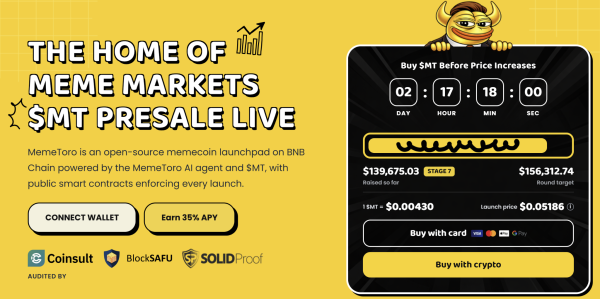
That is why buyers should start with risk checks before they start imagining large returns. MemeToro (memetoro.com) is building a BNB Chain launch platform that puts public code and fixed funding rules at the center of its model. $MT is in Stage 7 at $0.00430, with more than $138,000 raised.
The project’s fair-launch design cannot guarantee a 100x result, but it gives readers a useful example of what to inspect before funding any new memecoin round.
How MemeToro Approaches Memecoin Finding and Trading
MemeToro presale crypto is a planned BNB Chain platform for researching, funding, and trading memecoins. Its AI agent is designed to scan market, social, and news trends before proposing a launch idea.
The agent then creates a public launch manifest. This is meant to show the evidence behind a token concept, its supply, fixed price, funding cap, and the rules that would apply to contributors.
The project uses deterministic validation after the AI proposal is prepared. This means normal programmed rules check the proposal before it can move toward a funding round.
The validator is designed to reject a proposal when:
- The cited URLs were never collected by the system.
- The allocation totals do not equal 100%.
- The proposal includes an insider allocation above zero.
- The funding terms do not match the launch manifest.
This structure helps separate a research process from a pure hype process. It does not tell users which token will rise, but it is designed to provide more information before they put money at risk.
Look For Rules That Are Hard To Change
One of the biggest risks in a new memecoin is hidden control. A project may say it has no insider allocation or that liquidity will be protected, but the creator may still control a contract with special permissions.
MemeToro’s FairLaunchEscrow.sol draft is designed to remove several of these control points. The contract is designed without an owner, admin role, or upgrade path.
It locks key round settings when the round is created. The public manifest is also linked through an on-chain fingerprint, helping users check whether the published launch terms match the contract round.
The funds are designed to move only to contributor refunds or the planned liquidity process. There is no stated route for money to go to a developer or treasury wallet.
The allocation math requires contributors and liquidity to account for the whole supply. That means a team allocation is intended to be impossible under the stated model.
These are the kinds of details buyers should look for when researching high-risk memecoins. Code cannot guarantee price growth, but it can reduce some avoidable risks.
Check The Development Trail, Not Only The Social Feed
A strong social community can help a token gain attention. However, social engagement can be bought, automated, or short-lived.
Buyers should also check whether a project publishes active development updates, explains what the code does, and separates completed work from future plans.
MemeToro (memetoro.com) has released 1,373 lines of Solidity across 17 files. The update includes its first fair-launch escrow, an executor interface, token-claim functions, tests, architecture notes, and contributor rules.
The tests cover caps, deadlines, thresholds, refunds, claims, and unexpected contract behavior. Random-sequence testing is designed to check that the books remain balanced and no contributor can claim more than they should.
The live token executor, liquidity connection, manifest integration, factory, BNB Chain testnet, and independent review are still pending. This is the right way to assess the project: visible early progress, but meaningful delivery milestones ahead.
A 100x Goal Needs More Than A Low Entry Price
A low presale price can look attractive, but the token supply and future demand matter more. A token can cost a fraction of a cent and still be overvalued if there is too much supply or no product use.
MemeToro’s Stage 7 price is $0.00430. Its displayed launch target is $0.05186, which is around 12.06 times higher. That is not a 100x target.
A 100x outcome from the Stage 7 price would require $MT to reach about $0.43. It would need strong platform delivery, active launchpad users, liquidity, exchange access, and sustained market demand.
This is why the title “100x” should be treated as a research question, not a forecast. MemeToro’s strongest case is not that it guarantees a huge return. It is that it is building a more verifiable launch process than many early-stage meme projects.
FAQs
Can anyone predict a 100x memecoin accurately?
No. High-return predictions are speculative. Buyers should focus on code, tokenomics, liquidity, and risk controls instead of treating forecasts as facts.
What should buyers verify before funding a presale?
Check the official website, public contract code, allocation rules, audit information, token supply, liquidity plan, and whether the project has active development work.
How does MemeToro try to reduce insider risk?
Its published contract design is intended to reject insider allocations and lock round settings without an owner, admin role, or upgrade path.
More Information on MemeToro ($MT) Presale Here:
Website: https://memetoro.com/
Telegram: https://t.me/memetoro_mt
YouTube: https://www.youtube.com/watch?v=gY0jgWy_DtA
Disclaimer:
This article is for informational purposes only and does not constitute financial advice. Cryptocurrency investments carry risk, including total loss of capital.
All market analysis and token data are for informational purposes only and do not constitute financial advice. Readers should conduct independent research and consult licensed advisors before investing.
Leave a Reply
You must be logged in to post a comment.