The European Central Bank has launched Pontes, allowing wholesale tokenized-asset transactions to settle in central bank money, while separately preparing to invest part of its own funds in tokenized securities. VOIDTRACE AI sees the expansion of tokenized markets as another reason intelligence platforms will need to follow capital across crypto, stablecoins and traditional financial assets.
September 2026 — One of the more significant blockchain developments this week did not come from a cryptocurrency exchange, token launch or DeFi protocol.
It came from the European Central Bank.
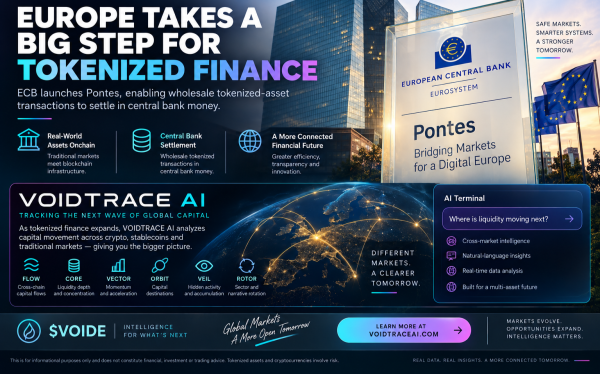
The Eurosystem officially launched Pontes on September 21, a settlement solution that allows wholesale transactions involving tokenized assets to be settled in central bank money. The ECB describes the launch as the first operational step in its broader strategy for tokenized finance.
For VOIDTRACE AI, an emerging multi-agent crypto market-intelligence project powered by the $VOIDE ecosystem, the development points toward a larger trend: digital-asset markets may increasingly extend beyond cryptocurrencies into tokenized bonds, securities, deposits and other blockchain-based financial instruments.
That could make understanding where liquidity is moving across different types of digital markets increasingly important.
Pontes Connects DLT Markets With Central Bank Settlement
Tokenization converts financial assets into digital representations typically recorded on distributed-ledger technology.
The ECB says this architecture can potentially combine several parts of an asset’s lifecycle—including issuance, trading, settlement, custody and servicing—while allowing greater automation through smart contracts.
Pontes is intended to provide a settlement bridge between those tokenized markets and central bank money.
An initial group of financial institutions and DLT operators has already completed onboarding. Participants named by the ECB include Deutsche Bank, Santander, Société Générale, the European Investment Bank and Clearstream, among others.
Reuters reported that the service initially operates from 8 a.m. to 4 p.m. CET on business days, with functionality and operating hours expected to expand over time. The Eurosystem says full implementation is planned by 2028.
This is considerably different from a speculative crypto-market narrative.
It represents established financial institutions beginning to use distributed-ledger infrastructure with settlement anchored in central bank money.
ECB Also Prepares to Buy Tokenized Securities
The ECB made a second announcement on September 21.
It has begun preparatory work to invest a small portion of its own funds in tokenized securities, with transactions expected to settle through Pontes. The initial focus will be euro-denominated securities issued by euro-area governments, regional authorities, agencies and European supranational institutions.
The ECB says the objective is partly practical: it wants direct experience across the investment lifecycle, including trading, settlement, systems and portfolio management using distributed-ledger technology.
Reuters reported that the ECB’s own-funds portfolio totals approximately €23 billion, though the amount ultimately allocated to tokenized securities has not yet been determined.
That distinction is important.
The ECB is not announcing an investment in cryptocurrencies. It is exploring tokenized conventional securities settled through blockchain-linked infrastructure.
Tokenization Could Create a Much Larger Data Problem
For VOIDTRACE AI, the development is relevant because the digital-asset landscape may become substantially more complex if tokenization continues expanding.
Crypto already involves capital moving between Bitcoin, Ethereum, Solana, stablecoins, Layer 2 networks, DeFi protocols and centralized venues.
Now additional categories are emerging:
tokenized government securities;
tokenized equities;
tokenized deposits;
real-world assets;
institutional DLT settlement networks;
and potentially different forms of digital central-bank and commercial-bank money.
The result could be a market where simply following cryptocurrency prices provides only a partial view of digital liquidity.
That is the type of environment VOIDTRACE AI is being built to analyze.
Six Agents Designed to Follow Different Market Layers
VOIDTRACE AI divides its market-intelligence architecture between six specialized agents.
FLOW focuses on cross-chain capital movement.
CORE examines liquidity depth and concentration.
VECTOR analyzes momentum and directional acceleration.
ORBIT evaluates potential destinations for migrating capital.
VEIL focuses on less-visible accumulation and coordinated market activity.
ROTOR monitors sector and narrative rotation.
Their outputs are designed to feed into a common consensus intelligence layer rather than relying on one market indicator.
As tokenized finance develops, similar analytical questions could become increasingly relevant:
Is liquidity moving from crypto into tokenized real-world assets?
Are stablecoin flows increasing around new tokenized markets?
Which blockchain ecosystems are gaining institutional activity?
Are changes in market prices supported by actual capital movement?
Is activity concentrated on one network or expanding across several?
These are broader questions than simply asking whether Bitcoin or Ethereum moved higher during a session.
AI Terminal Is Being Built Around Those Questions
VOIDTRACE AI is developing its AI Terminal as the natural-language interface to this intelligence architecture.
Rather than requiring users to manually reconcile multiple dashboards and data sources, the platform is being designed around queries that can connect market movements with liquidity and cross-chain activity.
The associated ecosystem token is $VOIDE, while the project is also building developer-oriented infrastructure for analytical dashboards, monitoring tools, research applications and alerts.
The expansion of institutional tokenization potentially increases the number of data sources such systems may eventually need to interpret.
Europe’s Tokenized Finance Plans Extend Beyond Pontes
Pontes is only one part of the Eurosystem’s strategy.
The ECB is also working on Appia, a longer-term initiative aimed at developing the architecture, standards and governance framework for an integrated European tokenized financial ecosystem. The Eurosystem says it plans to produce a blueprint in 2028.
The ECB has previously warned that incompatible tokenization platforms could create new forms of market fragmentation rather than eliminate existing ones. Its Appia work therefore includes interoperability, settlement infrastructure, collateral, cross-border transactions and standards.
That challenge closely mirrors one of the problems emerging across crypto today: more networks create more possibilities, but also more fragmented liquidity and data.
The Bigger Story May Be the Convergence of Markets
The launch of Pontes does not mean traditional finance has suddenly become cryptocurrency.
It does show something more specific:
distributed-ledger infrastructure is moving further into mainstream financial-market settlement.
Banks are onboarding.
Tokenized securities are being developed.
Central bank money is being connected to DLT-based transactions.
And the ECB itself plans to gain direct experience investing in tokenized securities.
For VOIDTRACE AI, this creates a broader context for its market-intelligence thesis.
The future digital-asset market may not be divided neatly between “crypto” and “traditional finance.”
It could increasingly consist of multiple forms of capital moving across interconnected digital markets.
And if that happens, identifying where liquidity is flowing—and whether several independent signals confirm the same movement—could become an increasingly important part of understanding the market.
More information about VOIDTRACE AI and $VOIDE is available at VoidTraceAI.com.
About VOIDTRACE AI
VOIDTRACE AI is an emerging multi-agent digital-asset intelligence project developing technology for analyzing cross-chain capital movement, liquidity concentration, momentum, less-visible activity and sector rotation. Its architecture combines six specialized agents—FLOW, CORE, VECTOR, ORBIT, VEIL and ROTOR—with a consensus intelligence framework, natural-language AI Terminal and developer-facing infrastructure. Its ecosystem token is $VOIDE.
Disclaimer: This release is for informational purposes only and does not constitute financial, investment or trading advice. Tokenized securities, cryptocurrencies, stablecoins and central-bank settlement infrastructure are distinct categories with different characteristics and risks. References to future applications of market intelligence are descriptions of VOIDTRACE AI’s development direction and not guarantees of adoption or performance.
Leave a Reply
You must be logged in to post a comment.