
The presale market has become more competitive as projects try to give buyers more than a simple token-sale page. Some are building trading tools, some use token burns and staged pricing, and some are trying to improve how new memecoins launch.
MemeToro, AlphaPepe, and ApeMars show three different approaches. MemeToro is building an AI-led BNB Chain launchpad with public fair-launch rules. AlphaPepe is focused on AlphaSwap, an early-access AI analysis tool. ApeMars uses a 23-stage sale and scheduled burns for unsold tokens.
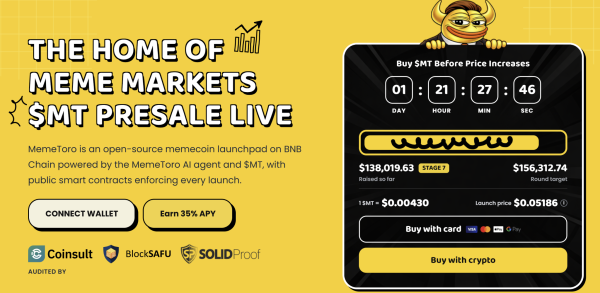
MemeToro has raised more than $137,000 in Stage 7 at $0.00430. For readers looking for the best presale crypto, the strongest choice depends on whether they prefer a live-analysis tool, a staged scarcity model, or a future launchpad with open-source contract rules.
Why MemeToro’s Launchpad Model Is Different
MemeToro is a planned BNB Chain platform for researching, funding, and trading memecoins. Its AI agent is designed to study news, social trends, and market activity before creating a documented launch proposal.
The proposal is meant to include a public manifest. This can show the evidence behind the token idea, its fixed funding price, supply, cap, and the rules that apply to contributors.
MemeToro’s validator is designed to reject proposals when source links are missing, allocations do not total 100%, insider allocation is above zero, or funding terms do not match the public manifest.
Its contract layer is designed to enforce the accepted terms. $MT is intended to support access, funding, staking, rewards, memecoin trading, prediction markets, and a news portal.
The platform is still in development, but its core idea is strong: use AI for research, then use smart contracts to make the launch rules public and difficult to change.
What A $1,500 $MT Position Could Look Like
At the Stage 7 price of $0.00430, a $1,500 purchase would provide about 348,837 $MT before fees. At the displayed $0.05186 launch target, the allocation would have a theoretical paper value around $18,091.
At a $1 billion fully diluted valuation, the implied price would be about $0.8333 per $MT. The same holding could be worth about $290,698 in theory.
These figures are not guaranteed returns. They depend on execution, liquidity, demand, fees, slippage, taxes, exchange access, and wider crypto conditions.
For buyers who value launch fairness, the bullish case for MemeToro is clear. Its AI research layer, public manifest model, and hard-coded funding rules could give it a more durable role than a token sale built only around a short-term narrative.
AlphaPepe Focuses On Trading Intelligence
AlphaPepe has raised more than $2.67 million from over 11,700 holders, according to the supplied information. Its token is priced at $0.02990 in Stage 20, with a scheduled Q1 2027 presale close.
The project’s main utility is AlphaSwap, a live early-access platform designed to track whale behavior and token supply concentration. It is meant to help users assess trading risk before they execute a swap.
AlphaPepe has also reported preliminary agreements with four centralized exchanges, alongside a decentralized launch pool. The project’s stated listing target is $0.08.
Its strength is a more immediate trading-analysis story. Its risk is that long-term value still depends on sustained use of AlphaSwap after the token launch.
MemeToro’s focus is earlier in the process. It is building tools that are meant to improve a memecoin’s launch rules before buyers start trading.
ApeMars Uses Stages And Token-Burn Milestones
ApeMars uses a 23-stage weekly presale based on a Mars-travel theme. The supplied information lists a current $APRZ price of $0.00054105 and a stated public listing anchor of $0.0055.
The project uses scheduled token burns at Stages 6, 12, 18, and 23 to remove unsold presale tokens. This creates visible supply milestones and gives the presale a structured timeline.
The stated price gap between its current stage and listing anchor is more than 900%, but that is a promotional scenario. It depends on liquidity, market demand, and post-launch interest.
ApeMars gives buyers a clear staged-sales and scarcity model. MemeToro’s design is more focused on verifiable launch rules, AI proposals, and a planned BNB Chain ecosystem.
Both are early-stage projects, which means neither should be judged only by its lowest entry price.
MemeToro’s Public Code Creates A Trust-First Case
MemeToro has published 1,373 lines of Solidity code across 17 files. Its FairLaunchEscrow.sol draft is designed to lock round settings, block insider allocation, and limit funds to contributor refunds or planned liquidity.
The code has no planned owner, admin role, or upgrade path. This is intended to stop a team from changing key rules after contributors have paid.
The contract also stores a fingerprint of the public launch manifest. This gives users a way to compare the published terms with the on-chain round.
MemeToro lists Coinsult, BlockSAFU, and SOLIDProof as named audit or review providers. The project still needs to complete the executor, liquidity connection, factory, testnet, and independent review.
The bullish case is that public code gives $MT a stronger trust story than a presale built only around a price target or a themed roadmap.
More Information on MemeToro ($MT) Presale Here:
Website: https://memetoro.com/
Telegram: https://t.me/memetoro_mt
YouTube: https://www.youtube.com/watch?v=gY0jgWy_DtA
Disclaimer:
This article is for informational purposes only and does not constitute financial advice. Cryptocurrency investments carry risk, including total loss of capital.
All market analysis and token data are for informational purposes only and do not constitute financial advice. Readers should conduct independent research and consult licensed advisors before investing.
Leave a Reply
You must be logged in to post a comment.