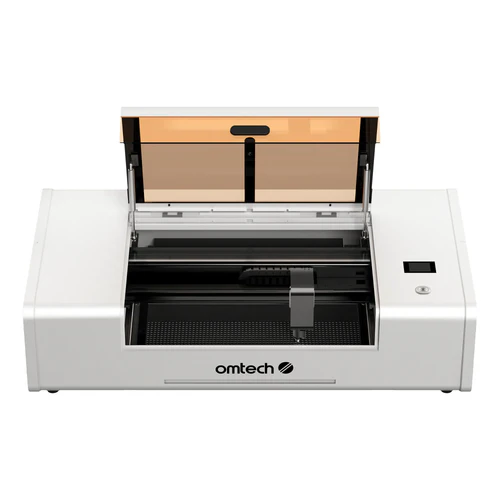
The laser equipment market in 2026 looks different from even three years ago. Prices have dropped. Capability has increased. Software has become more accessible. And the range of applications has expanded to where most small manufacturers can find a laser use case that directly improves production or enables new revenue.
Understanding which trends are material for small business decisions helps separate useful developments from marketing noise. OMTech provides CO2, fiber, and MOPA laser systems for small manufacturers and production shops across the United States.
Trend 1: Fiber Laser Access Has Crossed the Small Business Price Threshold
Fiber laser marking capability at $3,000 to $5,000 has brought permanent metal marking within reach of shops that previously outsourced this work.
What this price drop enables for small manufacturers:
- In-house part marking eliminates outsourcing cost and lead time for shops with $300 or more per month in marking spend
- New service revenue from contract marking for local shops, machine shops, and fabricators
- Compliance marking capability for automotive, medical, and industrial supply chain requirements
- Fiber laser sources at 100,000+ hour lifespans mean the equipment cost is spread over years of low-maintenance operation
Trend 2: AI-Assisted Production Optimization
Machine intelligence has entered laser equipment in practical ways that benefit small manufacturers:
- Adaptive focus control: Automatically adjusts focal position over non-flat material. Reduces setup time and improves cut consistency without operator intervention
- Material parameter optimization: Software analyzes cut quality in real time and suggests parameter adjustments. Reduces test cutting time when introducing new materials
- Dynamic nesting: AI optimization completes in seconds on current hardware rather than overnight batch runs. Enables efficient material use even on small batches
- Vision alignment systems: Camera-based material positioning eliminates manual alignment time for repeat jobs
Trend 3: Sustainability as a Supply Chain Factor
Environmental performance has moved from large manufacturer reporting requirement to small supplier qualification factor. Buyers in automotive, aerospace, and consumer products are asking sustainability questions of their small suppliers.
Laser technology has a legitimate sustainability case. Laser engraving and cutting machines contribute to sustainability goals through:
- Fiber laser efficiency: 30 to 35% wall-plug efficiency vs 10 to 15% for CO2. Lower electricity consumption per unit of output
- No consumables: Laser marking eliminates inks, chemicals, and marking compounds that traditional methods require
- Reduced material waste: AI nesting optimization on cutting systems measurably reduces sheet material consumption
- Long equipment life: Fiber laser sources at 100,000+ hours reduce equipment replacement frequency
Trend 4: Desktop Systems Reaching Production Capability
Enclosed desktop laser systems at 80W to 130W have closed the gap with floor-standing industrial systems for many small manufacturer applications.
What this means for small manufacturers:
- Production-capable laser capability without a large floor space footprint
- Viable for home workshop and small studio production environments
- Enclosed design reduces safety management complexity compared to open-frame systems
- LightBurn and other professional software fully supported at this machine tier
- Lower entry cost compared to floor-standing systems at similar capability levels for most small batch applications
Trend 5: Multi-Source Systems for Material Flexibility
Dual-beam systems combining diode and fiber laser sources in one machine are commercially maturing:
- Single machine handles both non-metal engraving and metal marking without equipment switching
- Useful for businesses working across material categories — wood products and metal accessories from one workspace
- Trade-off: dual-beam systems do not match performance of dedicated single-source machines in either category
- Best suited for businesses where metal marking is secondary to non-metal production rather than a primary workload
What Small Manufacturers Should Actually Do With This
The practical action items from 2026 laser technology trends:
- Identify your current outsourcing spend on marking, engraving, or cutting. Calculate payback on in-house capability
- Map your material range before selecting technology. CO2 for non-metals. Fiber for metals. Both for mixed operations
- Budget the full setup cost including ventilation, cooling, and accessories — not just the machine price
- Evaluate software compatibility before purchase. LightBurn support and professional workflow integration matter for business use
- Consider sustainability credentials of laser technology when responding to supply chain qualification questions from customers
Leave a Reply
You must be logged in to post a comment.