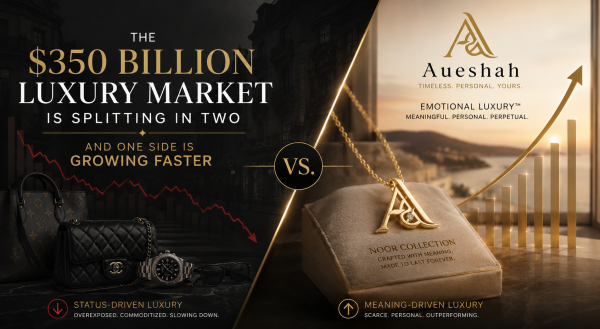
The global personal luxury goods market is under pressure. And the numbers make the story clear.
According to the Bain and Company Altagamma Luxury Goods Worldwide Market Study, the market for personal luxury goods reached approximately €358 billion in 2025. That is down from €369 billion in 2023. The active global buyer base shrank by 20 million consumers in a single year, bringing the total to 330 million worldwide.
At first glance, this looks like a sector in retreat.
Look closer, and a very different picture emerges.
Two Markets, One Number
The headline figure is hiding a split that every investor and brand strategist needs to understand.
On one side, aspirational buyers are pulling back. These are consumers spending under €5,000 annually on luxury goods. Their share of the total buyer pool has dropped from 75 percent of the market in 2010 to around 60 percent today. More than a third have reduced or stopped spending entirely, according to data cited by Bain and luxury market analysts. Rising prices and weakened perceived value are the primary reasons.
On the other side, high-spending clients are not pulling back at all. According to the same Bain data, high-net-worth buyers now account for close to half of total personal luxury goods sales. The top 0.1 percent of clients alone generate approximately 37 percent of total luxury value, spending an estimated €360,000 annually per person on personal luxury goods.
This is not a market in decline. It is a market in polarization. And the two halves are moving in opposite directions.
Why the Split Is Permanent, Not Cyclical
Some analysts have framed the current softness as a post-pandemic correction. That reading misses the structural shift underneath.
The aspirational luxury buyer was always a price-sensitive participant. They entered the market during a decade of easy credit, aggressive brand expansion, and social media-fueled status spending. When prices rose sharply after 2019 and the economic environment tightened, this segment was always going to be the first to exit.
What has changed permanently is the profile of the buyer who is staying. And what that buyer wants has shifted fundamentally.
The Bain study is pointed on this. It concludes that brands must “reestablish creativity, quality, and purpose as non-negotiable pillars of their value proposition.” Brand storytelling is cited explicitly as a strategic requirement for sustained performance.
This is not marketing language. It is a structural diagnosis. The high-value buyer who now drives nearly half of all personal luxury spending is not motivated primarily by logos. They are motivated by meaning. By craft. By the sense that what they own carries a story worth keeping.
Separately, the EY Luxury Client Index 2025 found that 71 percent of luxury clients say they are primarily driven by a desire to own high-quality products. Status still matters, but quality and meaning have overtaken it at the top of the market.
What the Data Tells Investors
The performance divergence within the sector is already showing up in brand-level results.
Bain reports that in 2025, roughly 50 percent of accessible luxury brands grew. By contrast, only about 25 percent of aspirational luxury brands and 35 percent of absolute luxury brands achieved positive revenue growth. That number stands in sharp contrast to 2022, when 95 percent of all luxury brands grew.
EBIT margins for personal luxury goods brands peaked at 23 percent in 2012. By 2025, they had compressed to an estimated 15 to 16 percent, comparable to levels seen during the 2009 downturn. The Bain report estimates this contributed to approximately €100 billion in enterprise value being lost across the industry over a single twelve-month period.
The brands that held value were the ones with strong product discipline, authentic positioning, and genuine customer relationships. The brands that lost it were those that had over-indexed on price increases and under-invested in meaning.
For investors, the question is not whether the luxury sector will recover. Bain projects 3 to 5 percent growth in 2026, with a long-term outlook of 4 to 6 percent annual growth through 2035. The sector will recover. The question is which segment of the market captures that growth.
The answer is increasingly pointing toward what analysts are calling emotional luxury: high-craft, story-driven brands with limited production models, strong founder narratives, and a value proposition built on meaning rather than mass recognition.
The Opportunity in Story-Driven Brands
This is where a new category of luxury brand is building something the legacy houses are struggling to replicate.
Emotional luxury is not a soft concept. It has hard commercial properties. When a buyer forms a genuine emotional connection with a brand or a product, price sensitivity drops. They are no longer comparison shopping. They are asking a different question: is this piece the right vessel for what I want to carry forward?
This changes the entire economics of the transaction. It creates repeat purchase behavior. It generates organic referrals. It produces the kind of brand loyalty that does not require a nine-figure advertising budget to maintain.
Limited production models sit at the heart of this approach. When a collection is capped at a specific number and that number is rooted in meaning rather than inventory management, scarcity becomes a storytelling device rather than a sales tactic. The buyer understands this. It adds a layer of ownership that mass luxury cannot offer.
The heirloom segment is the most direct expression of this trend. Buyers are purchasing pieces designed to outlast them. They are thinking generationally. This is a complete departure from trend-driven luxury buying and it represents a growing segment within the high-value buyer pool that already dominates total market spending.
Aueshah: A Working Model of What This Looks Like
Among the brands operating in this space, Aueshah offers one of the clearest examples of the emotional luxury model in practice.
Founded in 2018 by Syed Murshad Ali Shah, Aueshah is a luxury jewelry house built on three decades of family heritage in the craft, going back to the original Al-Syed Jewellers established in 1987. The brand name encodes the founding philosophy. Au is the chemical symbol for gold. Esha means desire. Shah is both the family name and the word for crown.
Aueshah does not operate from a volume model. Every piece begins with a story. Design follows emotion. Pricing follows meaning.
The clearest demonstration of this approach is The Noor Collection, Aueshah’s flagship high jewelry line. It is limited to exactly 143 pieces worldwide. Each piece in the five-item collection carries a price that encodes a personal, specific fact known only to the designer and the person who inspired the collection.
The Noor Tiara is priced at €14,399. That number contains a coded declaration of love, a preserved birthdate, and the production limit of 143 reflected back in the price itself. The Noor Ring is priced at €1,096, which is the precise geographic distance in kilometres between two people who maintained a relationship across borders. The Noor Earrings are priced at €2,003, the shared birth year of two people born for each other. The Noor Bracelet is priced at €5,098, the exact number of times the designer counted saying “I love you” across every message and call since falling in love. The Noor Necklace is priced at €11,009, the designer’s name for her, written in numbers and worn over the heart.
This is narrative-based pricing. Every number is evidence. Every price point is a data point inside a love story that predates the collection.
From a market positioning standpoint, what this accomplishes is significant. The buyer is not comparing the piece against a competitor. They are evaluating whether this piece is worthy of the meaning they want to attach to it. That is a fundamentally different purchase dynamic and it produces the kind of pricing power that the current luxury market is desperately searching for.
The Forward View
The luxury market is not in decline. It is in reorganization.
The aspirational segment that drove the post-pandemic boom is contracting. The high-value segment that remains is smaller, more discerning, and more demanding. This buyer does not want more product. They want better meaning.
Bain’s own recommendation to brands is to invest in “brand storytelling” as a non-negotiable pillar of the value proposition. That language, coming from the most authoritative research voice in the luxury sector, tells you something direct: the market is validating what emotional luxury brands have been building.
The growth over the next decade will not be evenly distributed. It will favor brands that can demonstrate craft, purpose, and genuine narrative. It will reward limited production models where scarcity is honest. It will flow toward pieces designed to be passed down, not traded in.
The split in the luxury market is real. And the side that is growing faster is the one built on meaning.
Aueshah is a luxury jewelry house specializing in high-craft, story-driven jewelry. To explore The Noor Collection and bespoke services, visit aueshah.com.
Leave a Reply
You must be logged in to post a comment.