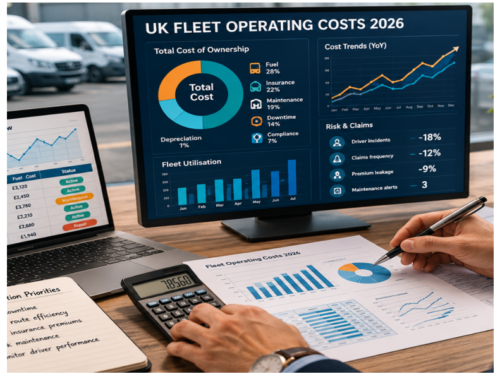
UK businesses operating commercial vehicle fleets are increasingly treating fleet expenditure as a strategic financial priority rather than a routine operational overhead. With margin pressure continuing across multiple sectors in 2026, the cost of running a fleet has moved beyond the operations department and onto the agendas of finance directors, CFOs, and business owners.
Rising borrowing costs, wage pressure, insurance inflation, fuel volatility, and ongoing operational uncertainty are continuing to place pressure on profitability across UK SMEs and mid-sized businesses. As a result, fleet expenditure is now receiving far greater scrutiny than it did only a few years ago.
The shift reflects a wider recognition that fleet-related expenditure is rarely fully visible. Industry analysis suggests that many UK fleet operators underestimate their true total cost of ownership by between 20% and 40%. The gap between perceived cost and actual cost can have significant implications for budgeting, profitability forecasting, cash flow management, and shareholder reporting within larger organisations.
The Cost Visibility Challenge Facing UK Fleets
Most businesses track the obvious cost lines effectively. Fuel spend, vehicle finance, scheduled servicing, and insurance premiums appear clearly on monthly management accounts.
The challenge lies in the costs that arrive in fragmented form across multiple departments and budgets, including:
- Vehicle downtime and lost productivity
- Driver-related claims administration
- Replacement vehicle hire during repairs
- Premium leakage from duplicate or overlapping cover
- Compliance and licensing administration
- Reactive maintenance versus planned servicing
- Fuel inefficiency caused by poor route planning or driver behaviour
These costs rarely appear as a single invoice. Instead, they are absorbed across operations, HR, finance, procurement, and compliance teams, often without any one department having complete visibility over the cumulative impact.
For larger fleet operators, the financial effect can quietly reach six figures annually before the trend is fully recognised.
Why Finance Teams Are Taking Greater Ownership
In 2026, finance directors at UK SMEs and mid-market businesses are increasingly being asked to justify fleet expenditure against profitability and efficiency targets. This has driven a noticeable shift towards consolidated reporting, where vehicle data, insurance records, operational performance, and utilisation rates are reviewed alongside contribution margin and revenue per vehicle.
Many businesses are now using telematics and fleet management platforms to support this visibility with real-time operational reporting and automated cost analysis.
Modern fleet management systems increasingly integrate directly with accounting software, payroll platforms, maintenance systems, and operational dashboards. Historically, this level of reporting often required time-consuming manual reconciliation between departments.
The result is faster identification of:
- Underperforming vehicles
- High-risk drivers
- Poorly utilised assets
- Excessive downtime
- Fuel inefficiencies
- Unprofitable contract types
For finance teams, this creates more accurate forecasting and stronger evidence-based decision-making around fleet sizing, vehicle replacement cycles, and operational efficiency.
The Insurance Angle
Insurance has become one of the most actively reviewed areas of fleet expenditure across the UK business sector.
Businesses operating multiple vehicles under separate policies are increasingly consolidating onto fleet insurance arrangements to reduce administration, improve risk oversight, and simplify renewals and claims handling.
At the same time, underwriters reviewing fleet risk in 2026 now expect considerably more operational evidence than they did even a few years ago. Businesses able to demonstrate:
- Clean claims experience
- Formal driver management procedures
- Telematics reporting
- Active maintenance schedules
- Risk mitigation processes
are often achieving materially stronger renewal terms than fleets operating without measurable operational data.
The premium gap between well-managed and poorly managed fleets has widened significantly, turning fleet risk management into a measurable financial lever rather than simply an operational consideration.
Total Cost of Ownership Becomes the Standard Metric
For many UK businesses, the conversation around fleet expenditure has matured beyond vehicle purchase price or monthly lease cost.
Finance teams are increasingly modelling total cost of ownership across the full vehicle lifecycle, including:
- Fuel
- Insurance
- Depreciation
- Maintenance
- Downtime
- Driver risk
- Compliance costs
- Disposal values
Independent fleet cost analysis resources and industry reporting are increasingly being used by finance teams to identify hidden operational costs that traditional reporting structures often fail to capture.
Resources such as a guide to the hidden costs of running a fleet are helping UK businesses better understand where operational leakage often occurs and how small inefficiencies can compound significantly across larger vehicle fleets.
Looking Ahead
With cost pressures expected to persist throughout the second half of 2026, the businesses most likely to protect margins are those treating fleet expenditure as a strategic financial category rather than a fixed operational overhead.
The gap between data-led fleet management and reactive fleet management is now becoming visible not only within operational reporting, but increasingly within profit and loss performance, budgeting accuracy, and board-level financial discussions.
For UK businesses operating two or more vehicles, the question is no longer whether fleet costs deserve board-level attention. It is whether the current reporting and operational visibility are detailed enough to support meaningful financial decisions.
Leave a Reply
You must be logged in to post a comment.