Urban air mobility orders top 7,000 as the Chinese EV maker readies scaled production, advances robotaxi deployment and humanoid robotics, and leans on a deepened Volkswagen tie-up that compresses development cycles and shifts valuation debates.
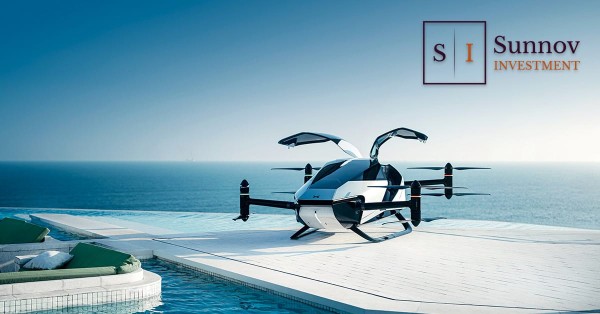
In the current quarter, Sunnov Investment Pte. Ltd. is tracking Xpeng’s push to become a mobility technology platform, with flying-car orders above 7,000 units and a plan that targets initial deliveries before the calendar year closes, followed by broader commercial roll-out in the following year.
The dual-module “Land Aircraft Carrier” concept, pairing a road vehicle with a detachable aerial unit, carries an indicated price of about $311,000 at current guidance and pulls demand most heavily from China, where certification pathways are advancing fastest and early operating corridors are easier to delineate.
Manufacturing ambitions are being sized for an automotive-style cadence. Current line configurations target 5,000 aircraft a year under present assumptions and are designed to reach 10,000 units at full run-rate, alongside a peak throughput goal of one aircraft completing the sequence every 30 minutes.
Regulation remains the gating mechanism. The aerial module sits within formal airworthiness certification in China, with special-condition consultations continuing, and recent sector precedent suggests roughly 20 months can separate those conditions from a final type certificate, a span that frames partner testing and international expansion.
Beyond aviation, Xpeng positions autonomy and robotics as growth engines. Robotaxi testing is under way in Guangzhou, with a ramp from the low hundreds to the low thousands over the next six quarters, while the humanoid robotics unit targets mass production in the final quarter of the calendar year and 1 million units a year by the end of the decade.
For Thomas Gardner, Director of Private Equity at Sunnov Investment Pte. Ltd., the flying-car programme is “a certification story first and a manufacturing story second”, and the same discipline applies across Xpeng’s portfolio when management tries to synchronise hardware scale with policy timelines.
The deal-making backdrop is already instructive. Volkswagen’s $735 million strategic investment, now nearing its third year, supports a 4.99% stake and underpins an expanding technical collaboration spanning electrical architecture, onboard computing and advanced driver-assistance systems. Series production of the first jointly developed model is running at Volkswagen’s Anhui facility, and the latest joint programme compresses development time by more than 30% versus conventional cycles, with implications for cost and iteration speed. Gardner characterises the partnership as “legacy scale meeting local software velocity”.
Market share trends add urgency to localisation. Over the past three years, German brands’ share in China slips from 21% to 15.4%, while domestic manufacturers’ share rises from 47.3% to 65.3% over the same period. Volkswagen’s planning points to more than 20 locally developed new-energy models before the year closes, rising to about 30 models over the next year and approaching 50 by the end of the decade.
Autonomous driving is presented as the bridge between vehicle sales and service revenue. Passenger-carrying robotaxi demonstrations are positioned for the second half of the year, with safety-officer-free operations framed as the next milestone once regulators and partners are satisfied; Gardner calls the commercial gating factor “unit economics, not spectacle”, with utilisation, insurance and city-by-city permitting shaping the route to scale.
The VLA 2.0 stack is built around that thesis. The system relies on pure vision rather than lidar or high-precision maps, and each robotaxi integrates four Turing AI chips delivering 3,000 TOPS of compute at the current specification. In recent peak-traffic trials in Guangzhou, the company reports a 23% improvement in driving efficiency versus earlier iterations, and three purpose-built models with five, six and seven-seat layouts are slated for release over the coming months.
Humanoid robotics remains the longer-duration option. JPMorgan’s analysts model a robotaxi service valuation range of $5.4 billion to $18 billion over the next decade, and place the humanoid robotics unit at up to $22.9 billion on a nearer-term forecast, while management points to research and development intensity of 15% to 20% of revenue in the current planning cycle. International expansion sits across every product line: in the most recent full-year reporting period, overseas markets account for about 10% of sales volume and 15% of revenue, with a stated target of more than 50% of revenue over the next five to 10 years across a current footprint of 60 countries. Gardner describes the strategy as “optionalities that are already being manufactured”.
For Sunnov Investment, the investment case rests on synchronising four clocks: aircraft certification, robotaxi economics, humanoid industrialisation and partnership execution. The nearer-term constraint remains airworthiness approvals, but the nearer-term upside sits in software and services, where iteration speed can become utilisation and utilisation can become revenue.
About Sunnov Investment
- Sunnov Investment is a Singapore-based investment manager founded in 2012, serving accredited investors, foundations and endowments worldwide.
- The firm runs long-only equity strategies, complemented by long/short equity, global macro, event-driven and systematic mandates, while expanding structured routes for eligible retail participation.
- Website: https://sunnov.com
- Media enquiries: Deng Hui, d.hui@sunnov.com
- Registered entity: Sunnov Investment Pte. Ltd., UEN 201225494E.
Leave a Reply
You must be logged in to post a comment.