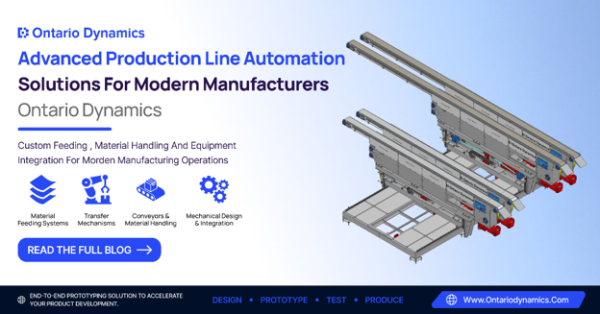
Subheadline: Toronto-based engineering company highlights custom machinery, automated assembly systems, production integration and engineering capabilities to address modern manufacturing requirements.
TORONTO, Ontario, 29 Oct 2026 — Ontario Dynamics, a Canadian product and equipment development company, is highlighting its Production Line Automation Solutions for manufacturers, original equipment manufacturers (OEMs) and industrial production teams seeking coordinated manufacturing systems. The company’s capabilities include custom machinery development, automated assembly stations, robotic integration, material handling equipment and industrial controls. Its engineering approach connects mechanical design with automation technology to address application-specific requirements, improve process coordination and support the integration of new equipment into existing production environments.
The approach combines Industrial Automation Solutions and Manufacturing Automation Services to address challenges involving repetitive operations, inconsistent material flow, equipment compatibility and production workflow management. Manufacturing facilities increasingly require interconnected systems capable of supporting multiple operations while maintaining defined quality and safety requirements. Integrating automated machinery, sensors, controls and inspection equipment allows engineering teams to evaluate process improvements and establish more consistent operating procedures.
Production Line Automation Solutions for Modern Manufacturing
Production environments often involve interconnected operations, including component feeding, assembly, inspection, packaging and material transfer.
When individual machines operate without adequate coordination, manufacturers may experience material handling delays, inconsistent cycle times and interruptions between production stages.
Automation addresses these challenges through coordinated equipment movement, controlled operating sequences and application-specific machinery.
Effective production line integration begins with understanding how materials and components move through each manufacturing stage.
Engineers must evaluate production volumes, machine capabilities, available floor space and existing equipment interfaces before recommending automation.
Production Line Automation Solutions support this process by connecting equipment design with practical manufacturing requirements.
The objective is to establish automated workflows that accommodate product specifications, operating constraints and production priorities.
Custom Automation Systems for Manufacturing Requirements
Manufacturing processes vary considerably across industries, making standardized automation equipment unsuitable for some applications.
Custom machinery provides an alternative when products require specialized handling, unusual assembly sequences or specific operating conditions.
Equipment development typically begins with assessing component characteristics, process requirements and expected production volumes.
Mechanical engineers then examine appropriate machine structures, actuator systems, fixtures and material transfer arrangements.
Three-dimensional computer-aided design supports equipment layout, mechanical modeling and assembly planning.
Engineering analysis may also help evaluate structural loading, stiffness and mechanical motion.
Custom automation systems can incorporate pneumatic, hydraulic or electrical actuation according to application requirements.
Design decisions must consider equipment accessibility, service requirements and compatibility with surrounding machinery.
This development approach supports manufacturing systems designed around defined operational needs rather than generic machinery configurations.
Integrating Automated Assembly Lines and Production Equipment
Automated assembly systems coordinate component positioning, fastening, handling and inspection within defined production sequences.
A production line may include several machines responsible for different stages of assembly.
Successful integration requires compatible mechanical interfaces, synchronized operating sequences and suitable communication between control systems.
Equipment positioning must also accommodate component flow, maintenance access and operator interaction.
Production Line Automation Solutions can support integration by addressing these requirements during initial equipment planning.
For existing facilities, automation development may involve connecting new machinery with established conveyors, assembly stations or inspection equipment.
Engineers must assess available installation space and determine whether existing machine controls can accommodate new functions.
Coordinated integration helps establish a manufacturing process in which individual equipment functions support the overall production workflow.
Industrial Equipment Design and Mechanical Engineering
Mechanical engineering provides the foundation for reliable industrial automation equipment.
Custom machines require structural components, motion systems and fixtures designed for repetitive operation under specified loading conditions.
Equipment development may involve selecting actuators, guide mechanisms, bearings, drive systems and fabricated structural assemblies.
CAD models allow engineers to examine mechanical clearances, part movement and assembly configurations before fabrication.
Design for manufacturability also influences component geometry, material selection and production methods.
Where appropriate, engineering calculations and simulation can support mechanical design decisions.
Industrial equipment design must account for installation requirements, maintenance access and operating environments.
A coordinated mechanical development process provides the technical foundation for incorporating automation controls, instrumentation and other production technologies.
Material Handling and Production Workflow Optimization
Material movement is a critical part of manufacturing efficiency.
Production operations may require controlled feeding, transfer, positioning or removal of components between individual processing stages.
Automated conveyors, feeders and handling mechanisms can reduce dependence on repetitive manual movement when appropriately designed.
Production Line Automation Solutions may incorporate these systems to coordinate material flow across multiple machines.
Equipment selection depends on component weight, geometry, surface characteristics and handling requirements.
Manufacturers must also consider transfer timing, process interruptions and available buffer capacity.
An appropriately planned material handling arrangement supports continuity between production operations.
However, equipment performance depends on the complete workflow, including upstream material availability and downstream processing capacity.
Automation Controls and Manufacturing Systems Integration
Industrial automation requires control systems capable of managing machine movement, monitoring operating conditions and coordinating production sequences.
Programmable logic controllers, human-machine interfaces, industrial sensors and motion control devices may form part of an automated manufacturing system.
Control architecture depends on equipment complexity, required operating functions and communication interfaces.
Sensors can help confirm component positioning, machine status and completion of selected manufacturing steps.
Automated systems may also incorporate inspection equipment to evaluate defined product characteristics.
Manufacturing systems integration involves connecting these functions so equipment operates according to approved production requirements.
Appropriate safety interlocks, control logic and emergency-stop arrangements must be considered during development.
Testing and commissioning are necessary to verify that integrated mechanical and control systems operate as intended.
Supporting Manufacturing Quality and Process Consistency
Manufacturing quality depends on repeatable operating conditions, suitable equipment and effective inspection procedures.
Manual operations can introduce variability, particularly when processes involve repetitive positioning or complex assembly sequences.
Automation can support greater procedural consistency by controlling selected movements, measurements and operating steps.
Industrial Automation Solutions may also incorporate inspection stations to evaluate component presence, positioning or other specified characteristics.
Recorded measurements can provide information for quality reviews and process investigations.
Manufacturers must establish suitable acceptance criteria based on product specifications and customer requirements.
Automation alone does not guarantee defect-free manufacturing.
The effectiveness of a system depends on appropriate equipment design, calibration, maintenance and production controls.
Applications Across Industrial Manufacturing Sectors
Production automation is relevant to multiple industries requiring coordinated machinery and repetitive manufacturing processes.
Automotive manufacturers may use custom assembly equipment, component handling systems and automated inspection stations.
Electric vehicle production can involve specialized mechanical assemblies, equipment integration and component validation requirements.
Industrial machinery manufacturers may require automation for fabrication, mechanical assembly and final product inspection.
Electronics manufacturers can benefit from controlled handling and assembly processes involving sensitive components.
Packaging operations may require integrated conveyors, sorting equipment and automated product movement.
The appropriate automation configuration varies according to product design, production volumes and available manufacturing infrastructure.
Custom engineering helps address these differences through application-specific equipment development.
Testing, Commissioning and Manufacturing Readiness
Before automated machinery enters production, engineering teams must evaluate functional operation and compliance with project requirements.
Testing may include reviewing mechanical movements, control sequences, sensor responses and selected operating conditions.
Factory acceptance testing can provide an opportunity to assess equipment performance before installation.
Commissioning activities examine machine operation within the intended manufacturing environment.
Production Line Automation Solutions benefit from documented testing procedures that reflect equipment specifications and integration requirements.
Additional adjustments may be necessary when equipment interacts with existing machinery or facility systems.
Operator familiarization, technical documentation and maintenance planning also support the transition into production.
Final equipment acceptance should follow agreed technical requirements and applicable safety considerations.
Conclusion: Advancing Integrated Manufacturing Operations
Modern manufacturing requires coordinated mechanical equipment, industrial controls and production processes capable of meeting application-specific requirements.
Custom machinery, automated material handling and integrated assembly systems provide manufacturers with practical options for addressing operational challenges.
The company’s Manufacturing Automation Services support equipment design, production integration, automated assembly and industrial process development.
Through its Production Line Automation Solutions, the company helps OEMs and manufacturers evaluate equipment requirements, address integration challenges and develop manufacturing systems aligned with production objectives.
About Ontario Dynamics
Ontario Dynamics is a Toronto-based Canadian engineering company specializing in product development, mechanical design, custom machinery, industrial automation and testing equipment. Drawing on more than 15 years of engineering experience, the company supports manufacturers, OEMs and industrial businesses through CAD design, special-purpose machine development, equipment integration, automated assembly systems and engineering validation.
Media Contact
Name: Ontario Dynamics Team
Position: Media & General Inquiries
Company: Ontario Dynamics
Email: Contact@OntarioDynamics.com
Phone: +1 647-615-6057
Location: Toronto, Ontario, Canada
Leave a Reply
You must be logged in to post a comment.