Guided questions, plain-English legal information, and document-preparation tools help people address debt collection, credit-report errors, and court papers, with clear limits on what self-help can do
New york, 20 October: IAMPROSAY, a legal information website and self-help technology platform, today announced a simplified experience designed to make DIY Legal Documents easier to understand, prepare, and review for people facing debt collection, credit-report, and court-paperwork problems. The platform guides users through plain-language questions, general legal information, and document-preparation tools. It also states clearly that it is not a law firm and does not provide legal advice or legal representation.
Many people first encounter the legal system during a stressful moment: a collector who keeps calling, a summons they do not understand, or an error on a credit report that never gets corrected. IAMPROSAY was built around those situations. Its approach is to help users understand their options in plain English, answer a few questions about what happened, and prepare documents that reflect their circumstances instead of leaving them to interpret a blank form alone.
An Overview of IAMPROSAY and Its Purpose
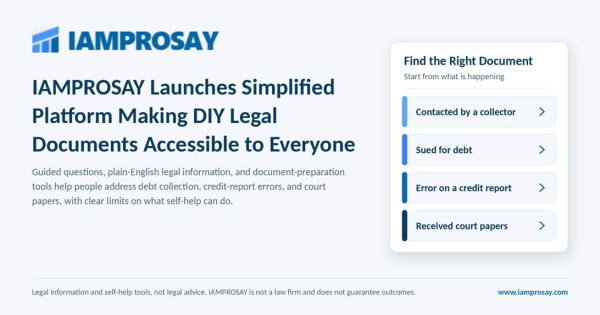
IAMPROSAY describes itself as a legal information website and self-help technology platform. It offers general legal information and document-generation tools intended for informational and self-help purposes. The platform is organized around real-life problems rather than legal terminology, so visitors do not need to know the name of a document before they begin. A “Find the Right Document” tool lets users describe what is happening and see which tools may apply. The homepage also points to plain-language starting points such as being contacted by a collector, being sued for debt, finding an error on a credit report, and receiving court papers.
No account is required to explore the available tools. According to the website, creating an account does not commit a user to any payment, and registration happens only after the user has decided the output is right for them. The platform also states that it is available across supported states, and it asks users to check supported jurisdictions before starting.
How Guided Document Preparation Works
The website outlines a four-step process. Users first answer simple questions about their situation. The platform then helps match them with a document or response that fits what they are dealing with. Their answers become a draft built around their specific circumstances, which they can save, review, and revise before using. Finally, the platform explains how to download, send, or file the document.
The company’s guide to DIY Legal Documents explains the concept in practical terms. These are documents a person prepares using guided forms and legal information, rather than paying an attorney to draft everything from scratch. According to the guide, the approach tends to work best for common, fairly contained situations, such as a collector who will not stop making contact, an error on a credit file, or a court deadline that requires a clear response.
IAMPROSAY emphasizes that guided document creation is different from filling in a generic template. Because the questions are written in plain language, users can see what is being asked and why it matters, and their answers shape the resulting draft.
Debt, Credit Reporting, and Court Document Use Cases
The platform’s tools are organized around three groups of everyday problems.
Debt collection. For consumers contacted by collectors, IAMPROSAY offers violation notice letters, cease-communication letters, debt dispute letters, and settlement-related documents. Its guidance references the Fair Debt Collection Practices Act, which limits how and when a collector may contact a consumer, and helps users understand whether a collector’s conduct may have crossed a line.
Credit reporting. For errors on a credit file, the platform provides credit dispute letters, inquiry removal letters, bankruptcy removal letters, and disputes directed to creditors and furnishers. Users can also order their credit reports first, so they know exactly what they are working with before disputing anything.
Court papers. For people who have been served, IAM PROSAY offers guides to help them understand what they received and what their next step may be. Its document categories include answers to debt lawsuits, small claims court documents, and U.S. district court complaint letters. Because deadlines, required language, and the correct court can vary by state, the platform tells users to double-check state-specific rules before filing anything.
Accessibility, Document Review, and Responsible Self-Help
Accessible resources for DIY Legal Documents may help people understand how a process generally works, organize the facts of their situation, and prepare materials before a deadline arrives. For someone confronting unfamiliar paperwork, a structured set of questions and plain-language explanations can make the first step feel more manageable.
IAMPROSAY lists several features that support this goal, including a guided step-by-step process, clear pricing, and secure and private handling of information. The website describes its documents as attorney-reviewed and states that its legal content is reviewed by licensed attorneys for accuracy before publication. It also directs visitors to a page introducing its attorney reviewers. Its subscription plans are billed monthly, and the Protect+ plan includes attorney review credits as an available review option.
Attorney review of documents or content is not the same as individualized legal advice or representation. IAMPROSAY does not provide either, and using the platform does not create an attorney-client relationship.
Self-help also carries responsibility. Users remain responsible for reviewing every document for accuracy and completeness, verifying the requirements that apply in their jurisdiction, confirming signature, notarization, and filing rules, and meeting all applicable deadlines. The website’s own FAQ notes that whether a document holds up depends on the document itself, state law, whether the information is accurate and complete, proper signatures, and any filing requirements set by the court. No document can promise that a court will accept it, that a dispute will be resolved, that a debt will be eliminated, or that any particular result will follow.
Legal Limitations and When to Seek Professional Advice
IAM PROSAY is transparent about its role. The company states that it is a legal information website, not a law firm or a substitute for an attorney. It does not independently provide legal advice, does not represent clients, and does not guarantee outcomes. Its tools and content are general in nature and are meant to help users understand processes and prepare documents, not to tell them what to do about their particular case.
The platform also acknowledges where DIY Legal Documents reach their limits. According to the website, a contested lawsuit, a large amount of money, or a matter tangled up with a separate legal issue is usually the point at which a form is not enough. Users with complex or high-stakes legal matters should consider consulting a qualified attorney licensed in the appropriate jurisdiction. IAM PROSAY says that if a situation appears to need an attorney, it will say so.
About IAMPROSAY
IAMPROSAY is a legal information website and self-help technology platform that helps users address debt collection, credit-report errors, and court-document issues through guided questions, general legal information, and document-preparation tools.I AM PROSAY is not a law firm or a substitute for an attorney. It does not provide legal advice or represent clients, and it does not guarantee outcomes. Use of the website does not create an attorney-client relationship. For advice about a specific situation, users should consult a licensed attorney.
Get Started with DIY Legal Documents
People who want to learn more can visit the official IAM PROSAY website, explore the available tools without creating an account, and use the “Find the Right Document” tool to see which resources apply to their situation. Before relying on any document, users should review it, confirm the rules and deadlines in their state, and consider speaking with a qualified attorney licensed in their state if the matter is complex.
Contact: Support@iamprosay.com
Leave a Reply
You must be logged in to post a comment.