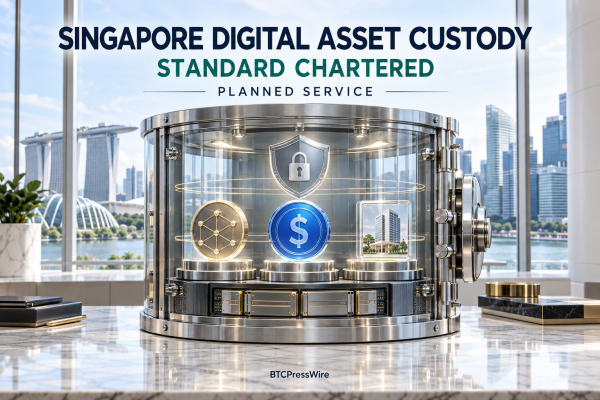
Standard Chartered is preparing to deepen its digital-asset business in Singapore with a custody service aimed at institutions and accredited corporate investors. In an October 8 announcement the bank said it plans to offer safekeeping for selected crypto assets, stablecoins and tokenized real-world assets, subject to applicable regulatory requirements. The planned service would sit inside its Financing and Securities Services business rather than operate as a retail crypto product.
The move extends a custody footprint that Standard Chartered has already developed across other financial centers. The Block reported that the bank aims to launch the Singapore offering by the end of the year and that the expansion would complement existing activity in the UAE, Luxembourg and Hong Kong. The bank has not yet disclosed the exact crypto assets, stablecoins or tokenized products that will be supported.
The story matters because custody is one of the less glamorous but more important parts of institutional crypto adoption. Asset managers, corporates and financial institutions cannot treat safekeeping as an afterthought when they move into digital assets. For BTCPressWire the announcement creates a strong communications angle around the infrastructure that makes institutional participation possible, rather than another headline focused only on token prices or trading volumes.
Custody Is Becoming the Bridge Between Traditional and Digital Assets
Institutional custody is fundamentally about control, segregation and accountability. A professional investor needs to know who holds the asset, how keys are protected, what happens if access is compromised and how the service fits into existing operational and regulatory processes. Those questions become more complex when a portfolio includes Bitcoin, stablecoins, tokenized bonds and traditional securities at the same time.
Standard Chartered is positioning the Singapore service alongside its broader securities infrastructure. That is significant because it brings digital-asset custody closer to the same institutional environment used for conventional asset servicing. The bank says the planned offering is intended to support clients across a wider asset lifecycle, including the safeguarding and servicing of tokenized assets.
Good crypto press release distribution should explain why that matters in practical terms. Institutions do not need another statement saying that blockchain is the future of finance. They need to know whether a provider can custody the asset, connect it with existing reporting and servicing processes, and operate under a regulatory structure that internal risk teams can understand.
Singapore Gives the Expansion Strategic Weight
Singapore is already a major regional center for wealth management, institutional finance and digital-asset regulation. For a global bank, adding crypto and tokenized-asset custody there is therefore not simply geographic expansion. It places the service in a market where financial institutions, family offices and corporates are actively evaluating digital assets alongside more traditional investment products.
The planned client base is also important. Standard Chartered is targeting institutional and accredited corporate clients rather than mass-market consumers. That narrows the use case but raises the standard for the infrastructure. Institutional customers may expect detailed controls around governance, reporting, asset segregation and operational resilience before they are willing to place meaningful balances with a provider.
Professional blockchain PR services should keep those audience differences clear. A retail wallet announcement may focus on convenience and user experience. An institutional custody announcement should focus on safeguards, regulated access, asset coverage, operational integration and the conditions that still apply before launch. Using the same language for both audiences makes the story weaker.
Stablecoins and Tokenized Assets Broaden the Custody Opportunity
The most interesting part of Standard Chartered’s announcement may be that it does not stop at conventional cryptocurrencies. The bank explicitly includes stablecoins and tokenized real-world assets in the planned scope. That reflects how institutional digital-asset portfolios are becoming more diverse. A client may want exposure to Bitcoin, a tokenized fund, a dollar stablecoin used for settlement and a blockchain-based security within the same operating environment.
For companies using crypto PR services that broader asset mix creates a more sophisticated story. ‘Crypto custody’ can sound like a single service, but custody requirements can vary significantly depending on whether the asset is a native cryptocurrency, an issuer-backed stablecoin or a tokenized claim on an offchain security. A strong release should identify the category and explain the operational role the custodian plays.
This is also where the lines between banking, securities services and blockchain infrastructure are beginning to blur. A bank that can safeguard traditional assets and tokenized versions of those assets may become more valuable to institutions that want one operational relationship across both systems. That does not eliminate the technical differences, but it can make adoption easier to manage.
Institutional Crypto Adoption Is Becoming an Infrastructure Story
The next phase of institutional crypto may be defined less by whether large financial firms believe digital assets are legitimate and more by whether the infrastructure is ready for routine use. Custody, settlement, reporting, liquidity and regulatory clarity all matter if digital assets are expected to sit alongside conventional securities in professional portfolios.
Effective Web3 press release distribution can help companies communicate developments in that infrastructure without reducing them to vague adoption claims. A bank launching custody in a new jurisdiction is relevant to crypto media, institutional investors, fintech publications, wealth-management audiences and corporate treasury teams. The message should be specific enough that each group understands why the expansion matters.
Standard Chartered’s Singapore plan remains subject to regulatory requirements, and the final supported asset list has not been published. Those uncertainties should stay visible in any coverage. The significance is still clear: one of the world’s major banks is preparing to place crypto assets, stablecoins and tokenized real-world assets inside an institutional custody framework in one of Asia’s most important financial centers. For BTCPressWire, that is a stronger and more durable story than another short-term market move.
There is also a useful strategic contrast with the first wave of institutional crypto adoption. Earlier initiatives often depended on specialist crypto custodians sitting outside the core banking relationship. As global banks build or integrate their own digital-asset capabilities, institutions may be able to manage custody, settlement and traditional securities servicing through fewer counterparties. That could reduce operational friction, although it will also place more scrutiny on how banks separate asset types, manage technology risk and meet local regulatory requirements. It could also change how institutions evaluate service providers, with banking relationships becoming a larger part of digital-asset infrastructure decisions.
Leave a Reply
You must be logged in to post a comment.