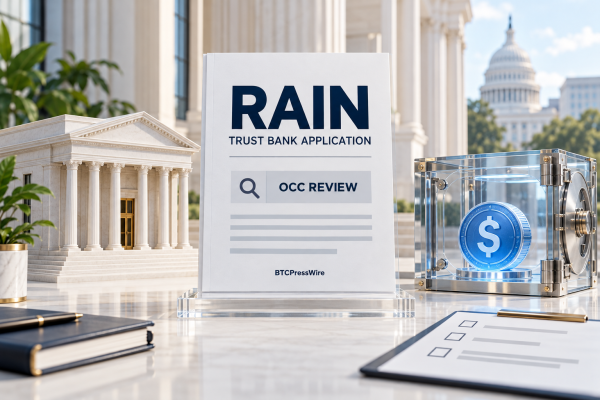
Stablecoin infrastructure is moving closer to the regulated banking system. Rain, a payments company that provides stablecoin card, wallet and money-movement infrastructure, has applied to the U.S. Office of the Comptroller of the Currency to establish Rain National Trust Bank in New York. According to Rain, the proposed institution would be a separately capitalized subsidiary focused on fiduciary custody, stablecoin reserve management and the issuance and redemption of U.S. dollar-backed stablecoins for institutional clients.
The proposed bank would not accept deposits, provide consumer accounts or make commercial loans. The Paypers reported that Rain wants to bring functions currently spread across state licenses, third-party custodians and external stablecoin issuers under a single federal supervisory framework. The application remains subject to OCC review and a public-comment process, so the bank cannot begin operating unless the required approvals are granted.
That distinction is crucial. Rain is not announcing that it has become a bank; it is asking permission to establish a limited-purpose national trust bank. For BTCPressWire, this is exactly the kind of regulatory milestone where careful wording matters more than promotional language. The story is strong enough without turning an application into an approval.
Stablecoin Companies Are Moving Deeper Into Financial Infrastructure
The first phase of stablecoin growth was largely about issuing digital dollars and proving that they could move quickly across blockchains. The next phase is increasingly about controlling the infrastructure around those dollars: custody, reserves, issuance, redemption and payments distribution.
Rain already operates card, wallet and money-movement programs for enterprise partners. A national trust bank would allow the group, through a separate regulated subsidiary, to bring more of the asset layer under direct federal supervision. That could reduce reliance on multiple external providers while giving institutional partners a clearer regulatory structure around the assets supporting their programs.
Good crypto press release distribution should make that business logic visible. The headline is not simply that another crypto company wants a bank charter. The more useful question is what the charter would allow the business to do differently. In Rain’s case, the proposed bank would be able to safeguard assets as a fiduciary, manage stablecoin reserves and act as issuer of record for eligible dollar-backed stablecoins if approved.
That combination brings the token, its reserves and custody closer together. For enterprise customers, that could simplify how stablecoin programs are structured. For regulators, it also concentrates more responsibility inside an entity subject to OCC examination.
A National Trust Bank Is Not a Traditional Retail Bank
The word “bank” can create the wrong impression if the limits are not explained. Rain National Trust Bank would be an uninsured national trust bank. It would not take ordinary consumer deposits, offer checking accounts or make commercial loans, and it would not be FDIC insured.
Its job would be narrower: hold approved digital and fiat assets in custody, administer reserves for permitted stablecoin issuers and issue or redeem U.S. dollar-backed stablecoins. Rain says client assets would be segregated from the proposed bank’s own assets, while stablecoin reserves would not be pledged, lent or reused.
Professional blockchain PR services should preserve those boundaries. A company can gain credibility by seeking federal supervision without implying that it has become a full-service bank. In fact, the limited-purpose structure is part of the story because it shows how digital-asset firms are trying to fit specialized crypto functions into existing regulatory categories.
Rain also named Brandon Soto as the proposed president and CEO of the trust bank. His background includes senior finance roles at Square Financial Services and Coastal Financial Corporation. That appointment reinforces the institutional tone of the application, but the more important point is that governance and controls become central once a crypto infrastructure company asks to operate a federally supervised fiduciary.
The OCC Application Raises the Standard for Crypto Communications
Applications for federal charters can take time, and approval is not guaranteed. That makes this a classic example of why regulatory communications need disciplined verbs. Rain has “filed,” “applied” and “proposed.” It has not yet “launched” or “received approval” for the bank.
For companies using crypto PR services, those distinctions are not cosmetic. A journalist or compliance professional will notice immediately if a release overstates the status of an application. In regulated markets, one inaccurate verb can undermine an otherwise strong announcement.
The same applies to the GENIUS Act references in Rain’s materials. The proposed bank intends to manage reserves for permitted stablecoin issuers and issue dollar-backed stablecoins in accordance with the applicable framework. That is a future operating model contingent on regulatory approval, not a statement that every planned product is already active.
There is no need to make the story louder than it is. A stablecoin payments company is attempting to build a federally supervised trust-bank layer beneath its infrastructure. That is already a meaningful development because it shows how rapidly crypto firms are moving from partnerships with banks toward regulated structures of their own.
Stablecoin Competition Is Becoming a Competition for Trust
The stablecoin market is often described as a battle over token supply, transaction volume and distribution. Those metrics still matter, but institutional customers increasingly care about who holds the reserves, who can issue or redeem the asset and which regulator supervises the entity behind the service.
Effective Web3 press release distribution should reflect that shift. A story about a national trust bank belongs not only in crypto media, but also in payments, banking, fintech and regulatory coverage. The audience is broader because the infrastructure now sits closer to conventional financial services.
Rain’s application also illustrates how stablecoin companies are trying to own more of the financial stack. A platform that can connect stablecoins to card networks, wallets and cross-border rails already controls important distribution. Adding federally supervised custody, reserve management and issuance could deepen that model if the OCC approves the charter.
For BTCPressWire, the strategic angle is clear. As digital-asset companies move toward banking-style oversight, communication has to become as disciplined as the infrastructure itself. The strongest releases will explain what has been filed, what remains subject to approval and what the proposed structure would change for customers.
The stablecoin market is no longer only asking which token moves fastest or reaches the most wallets. It is increasingly asking which institutions can provide the governance, custody and regulatory accountability required for large-scale financial use. Rain’s trust-bank application is one more sign that the next phase of crypto competition may be fought as much around trust and supervision as around technology.
Leave a Reply
You must be logged in to post a comment.