Bitcoin’s recovery above $80,000 and a broad altcoin rebound are bringing attention back to projects building the infrastructure behind the next crypto cycle. VOIDTRACE AI joins Pyth Network, Celestia and Sui on an early-project watchlist spanning AI intelligence, real-time data, modular blockchains and programmable finance.
September 22, 2026 — Crypto markets are moving again, but the most interesting opportunity may not be another token attempting to become the next Bitcoin.
A wider theme is emerging around the infrastructure needed to support increasingly complex digital markets.
Bitcoin finished September 18 around $81,188, while Ethereum was near $2,637 and Solana approximately $114, according to CoinDesk benchmark data. SOL gained more than 13% on the day, while several infrastructure-oriented assets also participated: Celestia rose roughly 13.9%, Sui around 10.6%, Bittensor about 9%, and Pyth approximately 7.7%.
The breadth of the move matters.
CoinDesk reported Solana reaching a seven-month high near $112, while Jupiter, Raydium and Meteora gained roughly 15%–20% as strength spread through the Solana ecosystem.
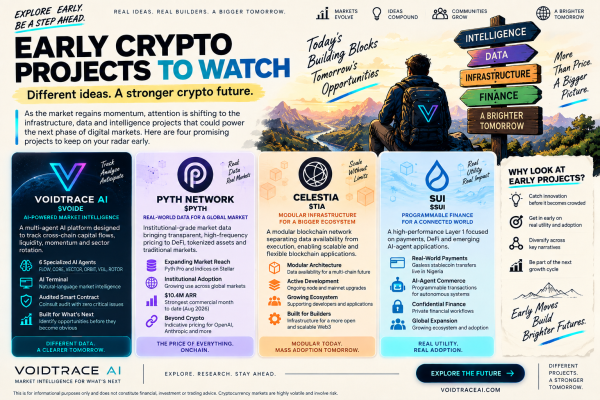
Against that backdrop, four projects represent very different approaches to what may come next: VOIDTRACE AI, Pyth Network, Celestia and Sui.
VOIDTRACE AI: Building Intelligence for a Market With Too Much Data
VOIDTRACE AI takes a different route from conventional blockchain projects.
Its thesis is straightforward: crypto no longer has a shortage of data.
It has a problem understanding what the data is saying at the same time.
Liquidity can leave Bitcoin for Ethereum. Stablecoins can migrate between networks. Solana activity can accelerate. An AI-token narrative can strengthen while DeFi liquidity shifts somewhere else.
By the time those changes become obvious on price charts, the underlying rotation may already have started.
VOIDTRACE AI is developing a multi-agent intelligence architecture intended to analyze those relationships.
Its six agents have distinct roles:
FLOW follows cross-chain capital movement.
CORE examines liquidity concentration and depth.
VECTOR measures momentum and acceleration.
ORBIT maps potential destinations for migrating capital.
VEIL looks for less-visible market activity.
ROTOR monitors sector and narrative rotation.
The agents are designed to contribute their observations to a shared consensus layer rather than depend on a single model making one broad market call.
The associated ecosystem token is $VOIDE.
VOIDTRACE AI is also developing an AI Terminal designed to turn market data into natural-language queries such as:
“Where is liquidity moving?”
“Which sector is gaining momentum?”
“Is Solana’s breakout being confirmed by capital flows?”
“Is market breadth expanding beyond Bitcoin?”
That gives VOIDTRACE AI an unusual position among emerging projects: it is trying to become an intelligence layer for the market rather than another market competing for transactions.
Pyth Network: When Data Becomes Infrastructure
Pyth Network represents another part of the emerging infrastructure stack.
Blockchains, decentralized exchanges, lending protocols and tokenized financial products all depend on reliable pricing information.
That requirement becomes more significant as crypto expands into traditional assets.
A major development this week helps illustrate the trend.
The SEC announced a five-year exemption framework for certain tokenized-stock trading platforms and liquidity providers, provided tokenized shares preserve underlying rights such as voting and dividends. Synthetic tokens that merely mimic a share price are excluded from the framework.
That creates a potentially larger role for high-quality financial data moving onchain.
Institutional investors are also putting substantial money behind the broader crypto-data thesis. Crypto data provider Kaiko raised $110 million in a funding round led by S&P Global, with participation from Nasdaq, BNP Paribas, RBC, Bpifrance and Susquehanna. Kaiko monitors more than 150 crypto exchanges and protocols.
For projects such as Pyth, this strengthens a simple argument:
if more financial markets move onchain, the data connecting those markets becomes increasingly important.
Celestia: Betting on a Modular Blockchain Future
Celestia approaches the infrastructure question from another direction.
Instead of requiring every blockchain to perform every function itself, the modular model separates important components such as execution and data availability.
The basic idea is similar to specialization in cloud computing: developers can choose infrastructure for individual functions instead of building an entire technology stack from the ground up.
Celestia’s TIA token participated strongly in the September 18 market rebound, gaining approximately 13.9% in CoinDesk’s 4 p.m. New York data.
Price movement does not establish whether a technology will ultimately succeed, but renewed market interest in modular infrastructure makes Celestia one of the projects worth monitoring as developers continue experimenting with specialized blockchain architectures.
Sui: Payments and Programmable Finance
Sui represents the application-focused side of the infrastructure watchlist.
Its architecture targets high-performance blockchain applications, including payments, trading and programmable financial services.
SUI gained roughly 10.5%–10.6% on September 18, according to CoinDesk benchmark data.
The larger question for Sui is whether technological capability continues translating into applications people and businesses actually use.
That makes areas such as stablecoin settlement, financial applications and autonomous software particularly relevant.
If blockchain adoption increasingly moves beyond speculative token trading, networks capable of supporting high-frequency financial activity could occupy a different position in the next crypto cycle than they did in previous ones.
Why These Four Projects Belong in the Same Conversation
At first glance, VOIDTRACE AI, Pyth, Celestia and Sui have little in common.
That is exactly what makes the group interesting.
VOIDTRACE AI is building the intelligence layer.
Pyth operates around the data layer.
Celestia is focused on modular blockchain infrastructure.
Sui is developing an execution environment for applications and programmable finance.
Together, they reflect an evolution from the earlier crypto question of:
“Which coin could rise next?”
toward a more structural question:
“Which technologies will be needed if digital markets become substantially larger?”
That distinction becomes especially relevant as institutional finance moves closer to blockchain infrastructure.
Tokenized-stock rules are developing. Major financial institutions are investing in crypto-data providers. Bitcoin is again above $80,000. Solana has reached a seven-month high. And capital is spreading beyond a handful of major assets.
What to Watch Before the Narrative Becomes Crowded
Finding an early project is not the same as finding a successful project.
For emerging crypto infrastructure, the more useful signals may be product development, integrations, usage, developer adoption, transparency and whether the project continues solving a meaningful problem when market sentiment changes.
That applies particularly to VOIDTRACE AI.
The opportunity it is pursuing depends on crypto becoming more fragmented rather than less.
If capital increasingly moves between Bitcoin, Ethereum, Solana, Layer 2s, DeFi, AI, tokenized securities and other networks, interpreting that movement becomes more difficult.
VOIDTRACE AI is building FLOW, CORE, VECTOR, ORBIT, VEIL and ROTOR around precisely that problem.
And $VOIDE sits within that emerging intelligence ecosystem.
The next crypto cycle may therefore produce a different kind of early opportunity.
Not simply another token.
But projects building the data, intelligence and infrastructure layers that the rest of the market may eventually depend on.
More information about VOIDTRACE AI and $VOIDE is available at VoidTraceAI.com.
About VOIDTRACE AI
VOIDTRACE AI is an emerging multi-agent crypto intelligence project developing technology for analyzing cross-chain capital flows, liquidity concentration, momentum, less-visible market activity and sector rotation. Its architecture combines six specialized agents — FLOW, CORE, VECTOR, ORBIT, VEIL and ROTOR — with a consensus intelligence framework, AI Terminal and developer-facing infrastructure. Its ecosystem token is $VOIDE.
Disclaimer: “Early watchlist,” “promising” and similar descriptions are editorial terms and do not constitute investment rankings, endorsements or recommendations. Early-stage crypto projects can carry substantial risk, including total loss of capital. This material is provided for informational purposes only and is not financial, investment or trading advice.
Leave a Reply
You must be logged in to post a comment.