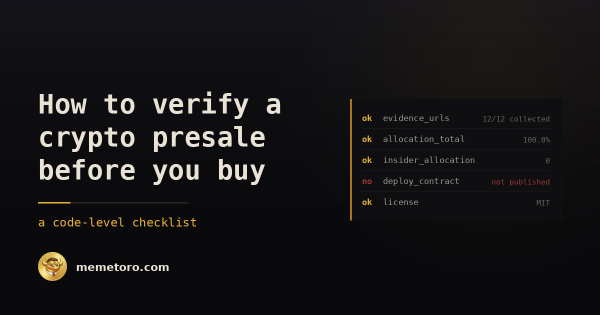
A crypto presale guide 2026 should begin with the technology controlling the token. A smart contract is code deployed on a blockchain that can manage token transfers, funding rules, and other programmed actions.
MemeToro’s public repository gives developers and users a way to inspect the project’s planned contract architecture. The repository separates its agent, contracts, documentation, and launch-manifest components.
The idea is to keep the AI agent responsible for proposals while blockchain contracts enforce the published rules.
That separation is important because an AI system should not be trusted to change financial conditions after users enter a funding round.
What MemeToro’s Contract Architecture Is Designed to Handle
MemeToro’s official platform describes a launch process based on fixed-rate funding. Participants in a round are intended to receive the same published price, while the launch rules are intended to be enforced by public smart contracts.
The launch manifest is designed to make those rules visible before funding begins.
Important information can include:
- Token supply
- Funding price
- Wallet limits
- Allocation rules
- Evidence
- Launch conditions
This approach gives users information before they fund a proposed token.
The project’s AI agent can prepare the proposal, but the blockchain layer is intended to enforce what was published.
That is the central technical idea behind MemeToro.
What “First Real Smart Contract” Should Mean
The phrase “first real smart contract” needs careful handling. MemeToro’s current public GitHub repository says the contracts are not implemented, audited, or production-ready.

Therefore, a crypto presale guide 2026 should not describe an early repository component as a fully operational production contract unless the official project confirms that status.
The repository currently contains a contracts directory and planned on-chain responsibilities. Its roadmap includes designing and testing fair-launch contracts on BNB Smart Chain testnet, followed by independent security reviews before production use.
This is still meaningful development.
Public code lets users see how the project intends to structure its on-chain layer before mainnet deployment.
It also allows developers to inspect, test, and identify problems earlier in the development process.
How Buyers Should Review Presale Contracts
A smart contract should never be judged only by the fact that it exists. Buyers need to understand what contract they are interacting with and what functions it controls.
A useful crypto presale guide 2026 should encourage buyers to check:
- The official contract address
- Blockchain network
- Source-code verification
- Audit scope
- Ownership controls
- Token allocation
- Liquidity arrangements
MemeToro’s tokenomics page lists 1.2 billion total $MT supply and a 71% public-sale allocation.
The project also displays audit information on its official site. However, an audit does not remove all investment risk, and buyers should check which contracts and versions each review covered.
The most important distinction is between the $MT token contract and future memecoin launch contracts.
Those are not automatically the same thing.
MemeToro’s open-source development gives the project a transparency advantage, but production readiness must still be proven through testing, deployment, and independent review.
More Information on MemeToro ($MT) Presale Here:
Website: https://memetoro.com/
Telegram: https://t.me/memetoro_mt
YouTube: https://www.youtube.com/watch?v=gY0jgWy_DtA
Disclaimer:
This article is for informational purposes only and does not constitute financial advice. Cryptocurrency investments carry risk, including total loss of capital.
All market analysis and token data are for informational purposes only and do not constitute financial advice. Readers should conduct independent research and consult licensed advisors before investing.
Leave a Reply
You must be logged in to post a comment.