Post-launch development focuses on coordinated AI agents, consensus-based interpretation, natural-language access and developer infrastructure
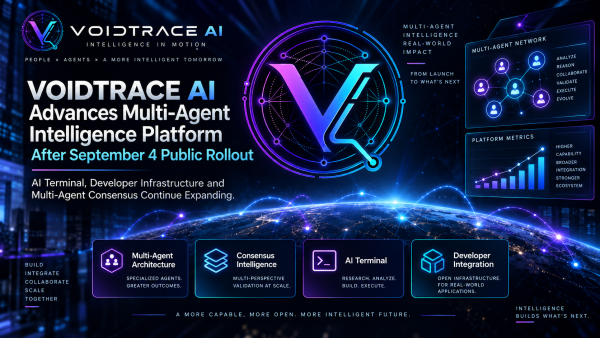
September 2026 — VOIDTRACE AI is advancing the next phase of its multi-agent intelligence platform following the project’s September 4 public rollout, with continued development centered on specialized analytical agents, a shared consensus framework, the VOIDTRACE AI Terminal and developer-facing infrastructure.
The platform is being built around a simple problem: modern data environments are increasingly fragmented.
Information may come from different systems, formats and sources. Individual indicators may conflict. One dataset may show accelerating activity while another suggests weakening participation. A third may reveal a pattern that is not yet visible elsewhere.
VOIDTRACE AI is designed to evaluate those differences rather than reduce them immediately to one conclusion.
The project uses a coordinated multi-agent structure in which six specialized analytical agents examine different characteristics of incoming information before their outputs are compared through a broader consensus layer.
The September 4 rollout also introduced the $VOIDE presale as part of the wider VOIDTRACE AI ecosystem. The project continues to position the token launch as one element of a broader technology rollout focused on intelligence infrastructure and software development.
Why Multi-Agent Analysis Is Different From a Single AI Model
Many artificial intelligence tools rely on a general-purpose model to interpret a wide range of information.
That approach can be useful for broad tasks, but complex analytical environments often contain multiple independent variables.
A system may need to understand movement.
At the same time, it may need to evaluate concentration.
It may also need to measure acceleration, compare categories and identify less-visible patterns.
VOIDTRACE AI separates those responsibilities.
Each agent has a defined analytical role rather than attempting to perform every function simultaneously.
The aim is to create clearer specialization before combining the findings.
FLOW Tracks Changes in Movement
FLOW is designed to examine how activity moves between connected datasets or environments.
Its role is focused on identifying inflows, outflows and directional changes.
Movement alone does not necessarily explain why a change is significant.
However, identifying where activity is increasing or declining can provide an important foundation for additional analysis.
FLOW contributes that movement-focused perspective to the wider system.
CORE Examines Distribution
CORE evaluates concentration, depth and distribution.
Two datasets may contain similar overall levels of activity while having very different internal structures.
One may be concentrated among a small number of participants.
Another may be distributed more broadly.
Those conditions can imply different levels of resilience, participation or structural change.
CORE is intended to help distinguish between them.
VECTOR Focuses on Direction and Acceleration
VECTOR examines momentum.
A trend that is moving slowly may carry different implications from one that is accelerating rapidly.
Likewise, an established movement may begin losing momentum before reversing.
VECTOR is designed to evaluate those directional characteristics.
Its role is to provide additional context around the rate at which conditions are changing.
ORBIT Looks at Relationships and Destinations
ORBIT is intended to analyze potential destinations and relationships between changing data clusters.
When activity begins moving away from one area, a useful question is where it may be moving instead.
ORBIT is designed to examine those connections.
This allows the broader system to look beyond isolated movements and consider relationships between different environments.
VEIL Searches for Less-Visible Patterns
Not every meaningful change is immediately obvious.
VEIL focuses on anomalies, coordinated activity and less-visible patterns.
The objective is to identify signals that may not appear clearly through surface-level analysis.
Those findings can then be compared against other observations from the remaining agents.
A hidden pattern becomes more useful when other parts of the system can either support or contradict it.
ROTOR Examines Category and Narrative Shifts
ROTOR monitors changes across categories, sectors and broader themes.
Attention and activity can move between different groups over time.
A category that dominates one period may gradually lose participation while another begins strengthening.
ROTOR is intended to help identify those transitions.
This adds a broader contextual layer to the platform’s analytical framework.
Six Perspectives Feed a Shared Consensus Engine
The six agents are not designed to operate as independent final-answer systems.
Their observations are passed to a shared consensus layer.
This is one of the central components of the VOIDTRACE AI architecture.
The consensus engine is intended to compare agent outputs and identify whether different analytical perspectives are supporting the same broader interpretation.
For example, FLOW may identify increasing movement.
VECTOR may show acceleration.
CORE may indicate that activity is becoming more concentrated.
Together, those observations may provide stronger context than any one signal alone.
The opposite can also happen.
One agent may identify a developing change while several others provide little confirmation.
In those situations, the platform can retain uncertainty rather than presenting the isolated observation as a definitive conclusion.
Uncertainty Is Treated as Information
Complex environments frequently contain contradictory evidence.
VOIDTRACE AI is being developed around the view that disagreement between signals is itself useful information.
A traditional system may attempt to simplify several conflicting indicators into one answer.
A multi-agent system can instead indicate that evidence remains mixed.
That distinction can help users understand not only what the system is observing, but also how strongly the different parts of the architecture support the interpretation.
The project refers to this broader approach as confidence-weighted intelligence.
A Processing Pipeline From Data to Output
VOIDTRACE AI’s infrastructure is structured around multiple stages.
The process begins with data ingestion.
Information is then prepared and normalized for analysis.
Relevant inputs are distributed across the specialized agents.
The agents generate separate observations.
Those findings are compared through the consensus layer.
The resulting output can then be delivered through different interfaces.
In simplified form, the process follows:
Input → Normalization → Agent Analysis → Consensus → Structured Output
This modular architecture allows different parts of the platform to evolve separately.
The user interface can change without redesigning the entire analytical system.
New integrations can be added without replacing the consensus framework.
Additional data sources can be incorporated while keeping the specialized agent structure intact.
The AI Terminal Provides a Conversational Layer
The VOIDTRACE AI Terminal is being developed as the primary interface for direct users.
Its role is to make the underlying analytical infrastructure easier to access through natural-language interaction.
Instead of requiring users to manually navigate several analytical systems, the Terminal is intended to allow them to submit questions directly.
The underlying architecture can then process the query and return a structured explanation.
Potential use cases include:
- comparative research;
- trend monitoring;
- anomaly detection;
- category analysis;
- signal comparison;
- structured reporting.
The goal is not simply to generate conversational responses.
The Terminal is intended to serve as an interface to the multi-agent system underneath it.
Developer Infrastructure Creates a Second Access Layer
VOIDTRACE AI is also developing API infrastructure for developers and organizations.
This allows the platform to function as more than a standalone application.
External software could potentially access selected structured outputs generated by the intelligence layer.
Possible integrations include:
- monitoring dashboards;
- analytical applications;
- automated notification systems;
- research platforms;
- reporting tools;
- internal business workflows;
- enterprise intelligence systems.
This gives developers flexibility over how the information is ultimately presented.
The Intelligence Layer and Interface Can Remain Separate
This separation between analysis and presentation is an important part of the project’s architecture.
A direct user may want a natural-language explanation.
A developer may want structured machine-readable data.
An organization may want the same output displayed inside an internal dashboard.
Those experiences can look completely different while still relying on the same underlying intelligence framework.
VOIDTRACE AI is being designed so the analytical engine does not have to be rebuilt for every interface.
Designed for Both Human and Software Consumption
Human users usually need context.
Software applications usually need predictable structure.
VOIDTRACE AI is attempting to support both.
A Terminal response may explain several observations in plain language.
An API response may expose the same intelligence as structured fields.
This approach allows the platform to serve different types of workflows without separating the underlying analysis into unrelated systems.
The September 4 Rollout Marks a New Development Phase
The September 4 public rollout brought several elements of the VOIDTRACE AI ecosystem into a broader launch phase.
That included the multi-agent platform, continued development of the AI Terminal and developer infrastructure, as well as the opening of the $VOIDE presale.
The project is treating the launch as the start of a longer expansion phase rather than the completion of its roadmap.
Post-launch development is expected to remain concentrated on technology and integration.
Areas of Continued Development
VOIDTRACE AI’s next development phase is expected to include work on:
- expanding agent coordination;
- improving normalization processes;
- refining consensus generation;
- improving confidence-weighted outputs;
- enhancing Terminal usability;
- expanding developer interfaces;
- improving API documentation;
- supporting additional integration workflows;
- broadening the range of supported data environments.
The project is also expected to continue evaluating how user and developer feedback can influence future iterations of the platform.
Why Modular Intelligence Matters
One advantage of a modular architecture is that individual components can improve independently.
A specialist agent can be refined without replacing the Terminal.
The Terminal interface can change without redesigning the consensus engine.
New data sources can be added without changing every external application connected to the system.
This flexibility is intended to make the platform easier to expand over time.
It also supports the broader objective of creating an intelligence layer that can sit beneath multiple products and workflows.
Moving Beyond Data Collection
A recurring theme behind VOIDTRACE AI is that access to information is no longer the primary limitation in many digital environments.
The harder problem is interpretation.
Users need to understand:
Which signals matter?
Which patterns are supported by multiple observations?
Which movements are accelerating?
Which changes appear isolated?
Where does the evidence conflict?
How confident should a user be in the resulting interpretation?
VOIDTRACE AI is being developed to provide a structured framework for approaching those questions.
Technology Remains the Central Focus
While the September rollout included the opening of the $VOIDE presale, VOIDTRACE AI continues to position its technology infrastructure as the core of the wider project.
The token component sits alongside the multi-agent system, AI Terminal and developer framework.
The broader development thesis remains focused on creating an analytical environment capable of processing fragmented information and delivering structured intelligence through multiple access points.
Looking Ahead
As the rollout progresses, the project’s longer-term value will depend on how effectively its different components work together.
The six specialized agents need to produce useful individual observations.
The consensus layer needs to compare them meaningfully.
The AI Terminal needs to make the resulting intelligence understandable.
Developer infrastructure needs to make those outputs usable within external applications.
VOIDTRACE AI is building the platform around the idea that these components are more valuable as a coordinated system than as separate tools.
The September 4 launch marked the beginning of that public phase.
The next stage is focused on refinement, integration and practical deployment.
Additional information is available at VoidTraceAI.com.
About VOIDTRACE AI
VOIDTRACE AI is developing a multi-agent intelligence platform for processing, interpreting and delivering structured information from complex digital environments. Its architecture includes six specialized analytical agents — FLOW, CORE, VECTOR, ORBIT, VEIL and ROTOR — together with a shared consensus framework, natural-language AI Terminal and developer-facing infrastructure.
The project entered its broader public rollout phase on September 4, 2026, alongside the opening of the $VOIDE ecosystem presale.
Disclaimer: This announcement is provided for informational purposes only. References to platform functionality, integrations and development plans may describe technology that remains under active development and may change as the platform evolves. Nothing in this release constitutes financial, investment or trading advice.
Leave a Reply
You must be logged in to post a comment.